

Smart sensor uses AI to detect fatigue with 92% accuracy
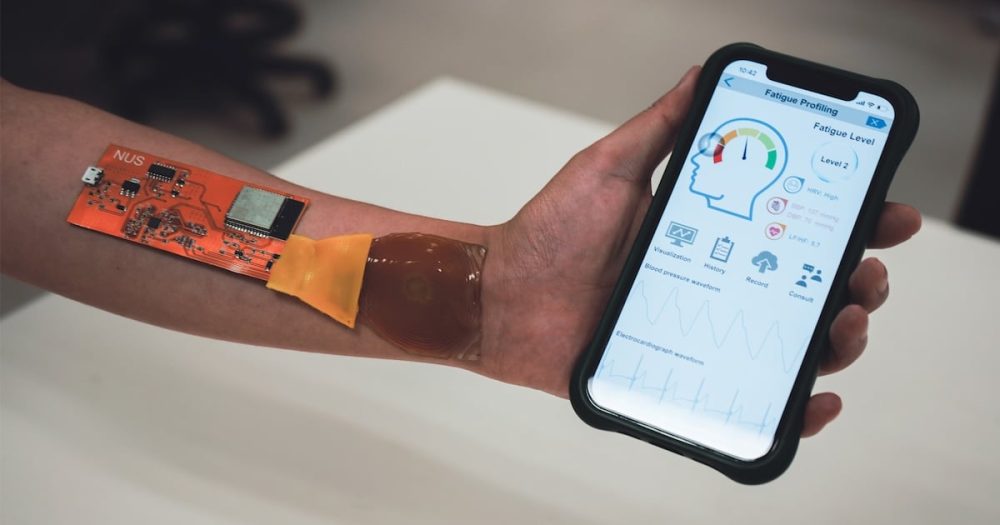
Researchers at the National University of Singapore have created an AI-powered sensor platform that detects fatigue with 92% accuracy. The system works by capturing clean physiological signals directly from the body, rather than trying to fix noisy data later.
Fatigue affects the autonomic nervous system and leaves measurable traces in heart rate variability, blood pressure patterns, and ECG waveforms. The challenge has been capturing these signals clearly while people move around in daily life.
How does it work?
The sensor platform uses a metahydrogel material with two built-in filtering systems:
- A nanoparticle structure that absorbs movement-related vibrations
- A liquid component that lets heart signals pass through while blocking unwanted noise
A machine learning algorithm then cleans up any remaining interference while keeping important physiological signals intact. The researchers describe the sensor as soft like biological tissue, breathable, and durable.
To train the system, the team collected continuous physiological signals from participants doing various activities, including simulated driving tasks. They paired this data with validated fatigue assessment scores to teach the AI to recognize fatigue patterns.
The system achieved an ECG signal-to-noise ratio of about 37 decibels during movement and a blood pressure deviation of around 3 millimeters of mercury, meeting ISO clinical-grade standards.
Why does it matter?
Current fatigue assessments rely mostly on self-reported questionnaires, which are subjective and only capture snapshots in time. Fatigue and mental health issues often develop gradually without obvious symptoms, but they affect cognitive performance, decision-making, and safety.
The Singapore team's approach tackles the problem at the sensor-body interface itself, rather than just using software to clean up noisy data after it's been captured.
"Current smartwatches typically achieve ECG signal-to-noise ratios of 10-20 dB, which can decrease by approximately 40% under motion due to artifacts and unstable contact. Our system achieves around 37 dB during daily activities," said Dr Tian Guo, the study's first author.
Beyond fatigue tracking, the system also reduced noise in other body signals, including:
- Heart and breathing sounds
- Voice patterns
- Brain activity
- Eye movements
The context
The research, published in Nature Sensors, builds on about four years of work. The team spent the past two years developing the metahydrogel approach and then integrating it into a complete system for real-world use.
Dr Tian explained that software-based signal processing "typically works after noise has already entered the system," making it hard to remove motion artifacts without affecting the underlying physiological signals. Many existing algorithms also "lack sufficient selectivity," often suppressing meaningful signals alongside noise.
"By engineering the material at the bioelectronic interface, we aim to selectively reduce mechanical and electrophysiological artifacts before they spread through the system. This way, software and AI can work with cleaner input signals from the start," he said.
The team is now working with mental health specialists to identify the most relevant physiological signals and determine the accuracy needed for clinical use. They're also seeking industry partners to turn the research platform into a commercial product.
"While the platform is still at a research stage, our immediate efforts focus on manufacturability, clinical interpretability, and large-scale validation," said study lead Prof Ho Ghim Wei.
Latest @
Blueprint lands in the UAE as longevity moves from policy to product
M42 launches 10,000-patient wearable pilot in Abu Dhabi to reshape chronic disease care
Unilabs Middle East and Takalam link diagnostics to mental health in one app
Al Ghurair enters healthcare with Trellis Health launch in Dubai
💡Did you know?
You can take your DHArab experience to the next level with our Premium Membership.👉 Click here to learn more
🛠️Featured tool
 Easy-Peasy
An all-in-one AI tool offering the ability to build no-code AI Bots, create articles & social media posts, convert text into natural speech in 40+ languages, create and edit images, generate videos, and more.
👉 Click here to learn more
