

Saudi Arabia and the UK want new medicines to reach patients faster
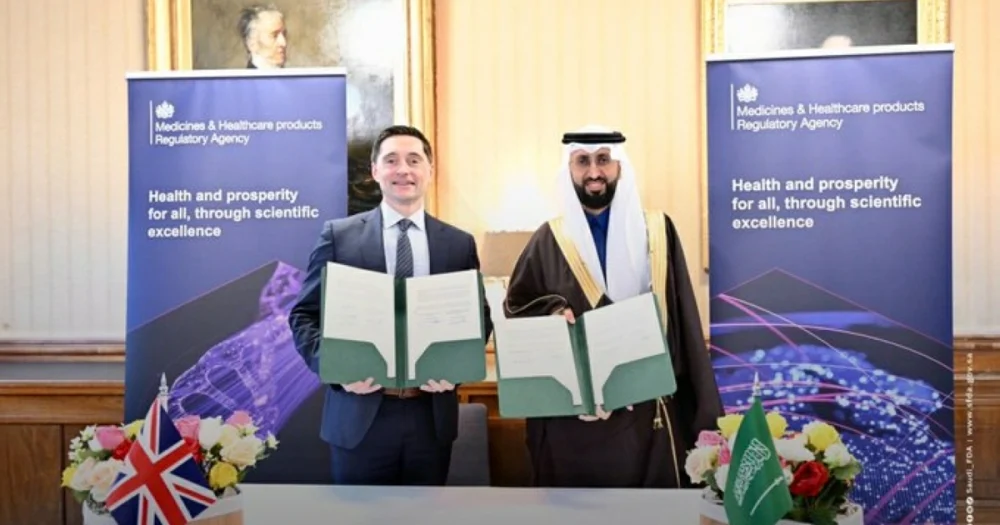
Regulators rarely make headlines, yet they decide how long a patient waits for a new drug. That is why a short memorandum signed in London this week deserves more attention than its length suggests.
The Saudi Food and Drug Authority (SFDA) and the UK's Medicines and Healthcare products Regulatory Agency (MHRA) agreed to work together on evaluating innovative treatments and getting them to patients on time. SFDA Chief Executive Officer Dr. Hisham bin Saad Al-Jadhey and MHRA Chief Executive Lawrence Tallon signed the MoU on the sidelines of the DIA-MHRA Global Summit, held on November 16 and 17. MHRA Chair Professor Anthony Harnden attended the signing.
How will it work?
The MoU covers the evaluation of treatments for rare diseases, advanced therapies and biotechnology products. It also sets up an exchange of expertise in several technical areas:
- Artificial intelligence, computer modeling and simulation in clinical studies and trials
- Registration and evaluation of medical products
- Good manufacturing practices and quality systems
- Product testing and analysis
- Supply chain monitoring
The aim is to make regulatory requirements clear to developers early, before they have spent years on a programme that misses the mark. That matters most for companies working on treatments for patients with few therapeutic options. The two authorities also expect to get better at spotting and tracking risks linked to medical products in both markets.
Why does it matter?
For patients with rare diseases, delay is not an inconvenience. It can decide the outcome. Small patient populations make trials hard to run, and regulators who share methods and expectations can cut some of that friction without lowering the bar on safety, quality or efficacy. Both sides stressed that the bar stays where it is.
The mention of AI and simulation is also worth watching. Modeling can reduce the number of participants a trial needs, or sharpen its design. But regulators must agree on how to judge such evidence. Writing that down together is better than each side improvising.
For manufacturers, the message is practical. A clearer route through two respected regulators makes the Saudi market a more predictable place to bring advanced products.
The context
This fits neatly into Vision 2030, which treats healthcare quality, local life sciences capacity and international partnership as national priorities. Saudi Arabia wants to attract pharmaceutical investment and build its own biotechnology base. A regulator that earns trust abroad helps with both.
The agreement also builds on existing cooperation between the two bodies. And it reflects a wider GCC pattern. The UAE and its neighbours have spent years strengthening regulatory systems, speeding up approvals and forming partnerships with established agencies, because investors and patients both notice which markets move quickly and which do not.
Still, an MoU is a promise, not a result. The test will come in the next two years: whether developers see shorter timelines, whether rare disease therapies reach Saudi patients sooner, and whether the AI collaboration produces shared guidance rather than just shared meetings. If it does, other regional regulators will likely take note.
Latest @
UTOPIA backs Mentix, putting surgical mentoring on Qatar's startup map
UAE-made diagnostic kits are about to travel further
Saudi Arabia and the UK want new medicines to reach patients faster
Abu Dhabi doctors perform the world's fifth reported transplant for NIK deficiency
💡Did you know?
You can take your DHArab experience to the next level with our Premium Membership.👉 Click here to learn more
🛠️Featured tool
 Easy-Peasy
An all-in-one AI tool offering the ability to build no-code AI Bots, create articles & social media posts, convert text into natural speech in 40+ languages, create and edit images, generate videos, and more.
👉 Click here to learn more
