

Mediclinic brings its hospital floors to Abu Dhabi’s health startups
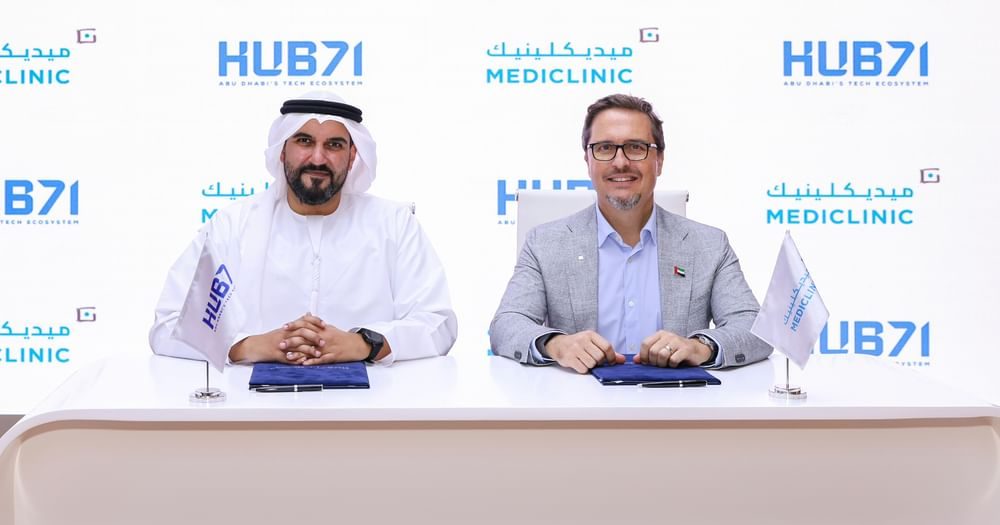
Most healthtech startups don't fail because the technology is weak. They fail because nobody let them test it where it counts. That gap between a promising prototype and a working hospital is exactly what Mediclinic Middle East and Hub71 say they want to close.
The two have announced a strategic partnership under which Mediclinic Middle East joins the Hub71+Life Sciences ecosystem in Abu Dhabi. The aim is to give startups building healthcare solutions closer access to clinical expertise and real-world insight from one of the region's established private providers.
How will it work?
The details published so far are broad, but the logic is clear. Mediclinic becomes a member of the specialist ecosystem, which means its clinicians and operational teams sit alongside the founders Hub71 already supports. Startups can put ideas in front of people who treat patients every day, and hear quickly whether a tool would help or just add clicks to a busy shift.
In practice, that kind of partnership usually covers a few areas:
- Clinical feedback on product design and workflows
- Guidance on regulatory and patient safety expectations
- Opportunities to pilot solutions in a live care setting
- Introductions to hospital decision-makers who buy technology
Pilots are the part to watch. A signed pilot inside a hospital group is often what turns a seed-stage company into a credible supplier.
Why does it matter?
Healthcare is a hard market for newcomers. Procurement is cautious, data is sensitive, and clinicians have little patience for tools built without them. Startups that get early clinical input tend to build products people actually use.
For Mediclinic, the benefit is just as practical. Hospitals face pressure on staffing, costs and patient experience, and outside innovators can offer fresh answers. Working with them early is cheaper than buying a finished product later.
But there's a wider point for the UAE. Abu Dhabi wants to be a place where health technology is developed and not merely imported. Connecting founders to a working provider is one of the more direct ways to make that happen.
The context
This fits a clear pattern across the Gulf. Abu Dhabi has spent years building its life sciences base, with Hub71 as the startup hub, the Department of Health setting policy, and a growing focus on genomics, AI-assisted diagnostics and digital records. Saudi Arabia is pursuing similar goals under Vision 2030, with health sector transformation and local innovation high on the agenda.
What the region has lacked is not capital or ambition. It is the connective tissue between young companies and the institutions that can validate them. Partnerships like this one try to supply it.
Still, announcements are easy and outcomes are slow. The test will be how many startups reach a live pilot, and how many of those pilots become contracts. If the numbers are good, other private hospital groups in the GCC will likely follow. If not, this will be another ecosystem badge. Healthcare leaders should watch the first cohort closely.
Latest @
Neuratia Labs picks CliniDataCue to solve the data problem facing its first research fellows
Robotics comes to the IVF lab as Abu Dhabi's fertility sector eyes automation
American Hospital Dubai to help build an AI billing platform, not just buy one
Mubadala and Khalifa University bet on lab-stage science with new life sciences programme
Abu Dhabi's biobank teams up with AstraZeneca to predict disease before it starts
💡Did you know?
You can take your DHArab experience to the next level with our Premium Membership.👉 Click here to learn more
🛠️Featured tool
 Easy-Peasy
An all-in-one AI tool offering the ability to build no-code AI Bots, create articles & social media posts, convert text into natural speech in 40+ languages, create and edit images, generate videos, and more.
👉 Click here to learn more
