

Dubai Health teams up with Rush University System for Health in new clinical and research partnership
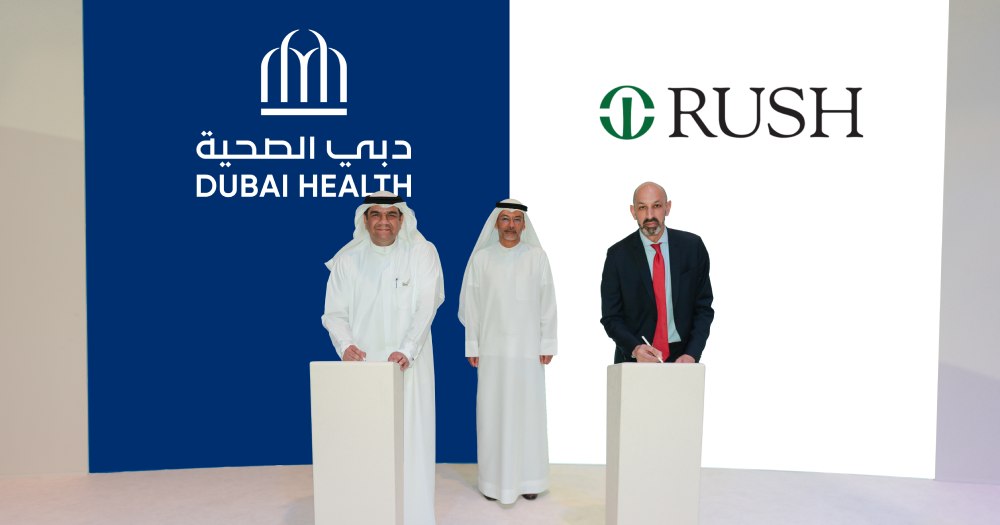
Dubai Health has signed a collaboration agreement with Rush University System for Health, a major US academic medical system known for its rankings in quality, patient safety, and experience. The deal brings together two large health systems with the stated goal of improving patient outcomes and sharing knowledge across borders.
The agreement was signed by Dr. Amer Sharif, CEO of Dubai Health and President of Mohammed Bin Rashid University of Medicine and Health Sciences, and Dr. Omar Lateef, President and CEO of Rush University System for Health and Rush University Medical Center. The signing took place in the presence of His Excellency Dr. Alawi AlSheikh-Ali, Director General of Dubai Health Authority.
This is not a narrow research deal. The partnership covers a wide range of areas, and both sides appear to be treating it as a long-term institutional relationship rather than a one-off project.
How will it work?
The collaboration sets out several areas where the two systems plan to work together:
- Clinical programs and care models
- Quality and patient safety
- Performance management
- Digital health
- Research and innovation
- Education and training across medical, nursing, allied health, and leadership roles
In practice, this means sharing expertise and knowledge rather than one system simply adopting the other's model. Dr. Lateef put it plainly: "We have much to learn from one another, with the ultimate beneficiaries being our patients."
Why does it matter?
For Dubai, the partnership is part of a broader push to establish the emirate as a serious global healthcare hub. Attracting partnerships with top-ranked US academic medical centers sends a clear signal to international patients and medical professionals about the direction Dubai Health is heading.
For Rush, the deal gives the Chicago-based system direct exposure to a Gulf healthcare market that is investing heavily in infrastructure, digital health, and workforce development. Gulf health systems have been on an aggressive expansion path, and US academic centers have increasingly looked to these partnerships as a way to test ideas across different patient populations and care settings.
Dr. Sharif framed it in terms of talent: "Supporting the development of qualified talent across disciplines and reinforcing Dubai's position as a global healthcare destination." That workforce angle matters because the UAE, like many fast-growing health systems, faces ongoing pressure to train enough qualified local and regional professionals to meet rising demand.
The context
Dubai Health is the emirate's main integrated public health authority, and it has been actively pursuing international academic partnerships as part of a wider government strategy to raise healthcare standards and attract medical tourism.
Rush University System for Health is based in Chicago and has a strong national reputation in the US, particularly for patient safety and care quality. It includes Rush University Medical Center, one of the country's better-regarded teaching hospitals.
This kind of cross-border academic health partnership has become more common over the past decade, with Gulf states in particular signing agreements with leading US, UK, and European health systems. The model typically involves knowledge exchange, joint research, and staff training rather than direct clinical operations in the partner country. Whether this agreement moves beyond that template will depend on how the two sides choose to use it over the coming years.
Latest @
Blueprint lands in the UAE as longevity moves from policy to product
M42 launches 10,000-patient wearable pilot in Abu Dhabi to reshape chronic disease care
Unilabs Middle East and Takalam link diagnostics to mental health in one app
Al Ghurair enters healthcare with Trellis Health launch in Dubai
💡Did you know?
You can take your DHArab experience to the next level with our Premium Membership.👉 Click here to learn more
🛠️Featured tool
 Easy-Peasy
An all-in-one AI tool offering the ability to build no-code AI Bots, create articles & social media posts, convert text into natural speech in 40+ languages, create and edit images, generate videos, and more.
👉 Click here to learn more
