

Apple wants to know if you trust health AI, and it is asking 200,000 people
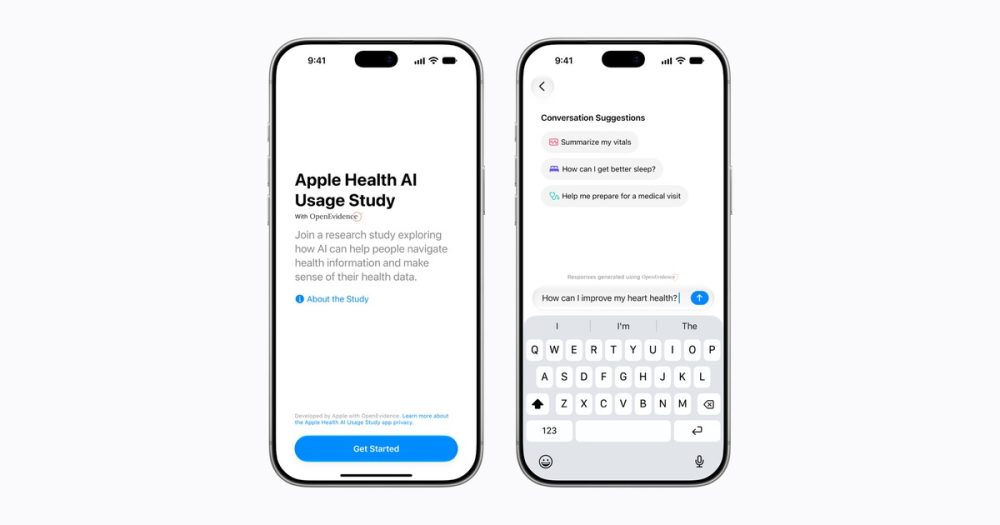
Before Apple builds a health chatbot, it wants to find out whether anyone should believe one. That is the quiet message behind the Apple Health AI Usage Study, a research project announced on November 15, 2026. It is a sensible order of operations, and one that regional health regulators would do well to notice.
The study is a virtual research programme, run through its own app, and it is open in the United States only. Up to 200,000 eligible adults aged 21 and older can take part. Apple is working with OpenEvidence, a clinical AI platform widely used by physicians, which generates answers from sources such as The New England Journal of Medicine, the Journal of the American Medical Association and Nature.
The goal is not to launch a product. It is to measure what drives user trust, how good the responses are, whether people understand them, and what they actually do afterwards.
How does it work?
Participants download the study app and choose whether to enroll. Inside, they can ask everyday health questions and receive answers written in approachable language. Each response is tied to linked, peer-reviewed clinical citations, so users can check the source themselves.
Participants can also choose to share HealthKit data, such as resting heart rate, activity, sleep or lab results. The researchers want to see whether personal data makes answers more relevant and easier to understand. And the study will explore whether health AI can help people prepare for appointments with their own doctors.
Eligibility is narrow:
- Age 21 or older, living in the United States
- An Apple Intelligence-enabled iPhone, meaning iPhone 15 Pro or later
- iOS 26 or later
On privacy, Apple says study data will not be used to train AI models. Participants control whether they share HealthKit metrics or survey responses. The app also includes safety guardrails meant to detect certain concerning questions and point users toward a provider or other resources.
Why does it matter?
Apple concedes something many technology firms avoid saying: consumer tools built on large language models can give answers that are incomplete or unclear. In health, that is not a small flaw. A confusing answer about a lab result can send someone into panic, or into false comfort.
Sumbul Desai, Apple's vice president of Health and Fitness, framed the study as a matter of scientific rigour. Robert Wachter, chair of medicine at UCSF, made the sharper point. Patients and clinicians are both turning to AI, he said, but the tools are being built and tested in separate worlds. If both sides use versions of the same trustworthy tools, patients arrive better prepared and consultations improve.
That is the real prize. The value of health AI may lie less in replacing a clinician than in making the first five minutes of a consultation more useful.
The context
For the Gulf, the timing is relevant. Residents here are among the most connected in the world, with high smartphone penetration and strong appetite for digital health. Saudi Arabia's Vision 2030 health transformation programme, the UAE's push for AI in care delivery and unified health records, and national platforms such as Malaffi in Abu Dhabi all assume that patients will engage with digital tools. They also assume those tools will be trusted.
Trust is the open question. Most evidence on health AI comes from clinical settings or benchmark tests. Far less is known about how ordinary people read, interpret and act on AI answers at home. Apple's study aims to fill part of that gap, though only for US users. Arabic-language performance, regional disease patterns and cultural attitudes to discussing health are not covered.
So GCC health authorities have a choice. They can wait for findings and adapt them, or they can commission comparable studies in Arabic and English with local partners. The second route is slower, but it would produce evidence that fits the region. Regulators in Riyadh, Dubai and Abu Dhabi already have the data infrastructure to try it.
Either way, the design principles are worth copying now. Cite sources. Keep data sharing optional. Build in safety prompts. Study the results before scaling. Apple has not said when the findings will be published, but the health sector in the Gulf should be reading them when they arrive.
Latest @
ChatGPT for Healthcare gets agents that click, type and chase the paperwork
WHOOP bets that a verified heartbeat can fix social media's bot problem
Huawei's first glucose monitor took 35 months to build, and it shows
Apple wants to know if you trust health AI, and it is asking 200,000 people
Morocco makes it easier to report a bad reaction to a medicine
💡Did you know?
You can take your DHArab experience to the next level with our Premium Membership.👉 Click here to learn more
🛠️Featured tool
 Easy-Peasy
An all-in-one AI tool offering the ability to build no-code AI Bots, create articles & social media posts, convert text into natural speech in 40+ languages, create and edit images, generate videos, and more.
👉 Click here to learn more
