

Tunisia bets on telehealth as it prepares to host Telehealth Connect 2026
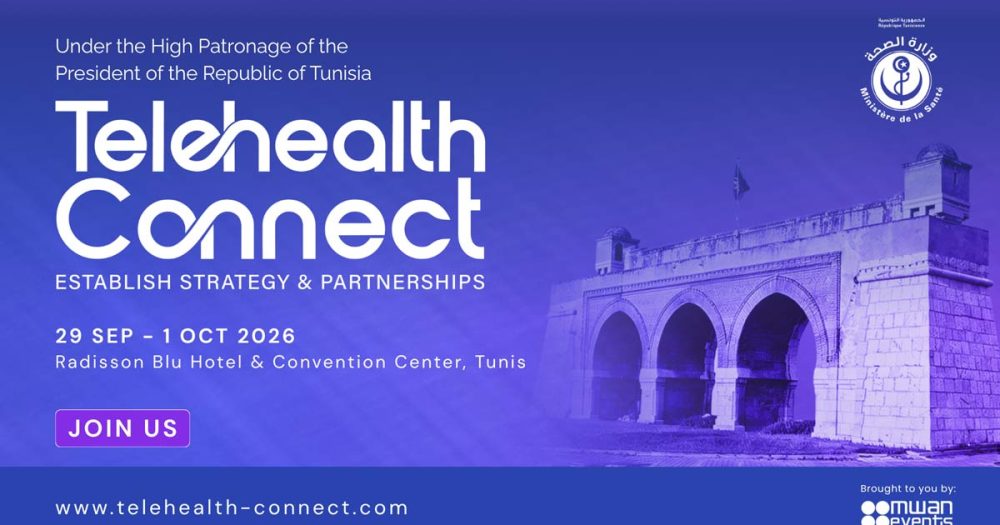
A country that has quietly deployed teleradiology across 30 facilities, conducted more than 100,000 remote examinations, and is preparing to launch a national patient-facing health platform does not need a conference to prove its credentials. But Tunisia is hosting one anyway. Telehealth Connect 2026, scheduled for 29 September to 1 October at the Radisson Blu Hotel and Convention Center in Tunis, is less about showcasing what has been built and more about what comes next — for Tunisia, for Africa, and for the wider Arab region.
What's the news?
Held under the patronage of the President of the Republic, Telehealth Connect 2026 will bring together more than 500 participants from 30 countries over three days. The attendee list includes ministers, government officials, representatives from international organizations, and healthcare institutions, alongside researchers, clinicians, and technology partners.
The conference will cover telemedicine and virtual care, health data interoperability, artificial intelligence in clinical settings, cybersecurity, and cross-border cooperation in telehealth. Practical workshops will run alongside the main programme, focused on workforce skills, AI governance, and the technical requirements of connecting health information systems across institutions and borders.
Supporting organizations include the World Health Organization, the World Bank Group, the International Telecommunication Union, and the Africa Centres for Disease Control and Prevention. Egypt's Ministry of Health and Population is also listed as a partner, alongside private-sector names including Huawei and Tunisie Telecom. The event is organized by MWAN Events.
On the domestic side, Tunisia's Ministry of Health has prepared a detailed account of where the country stands. Beyond the teleradiology rollout, 99 healthcare facilities are at various stages of implementing electronic medical records. The national health identifier, a foundational building block for any connected health system, has reached 800,000 active registrations. And the ministry is preparing to launch a citizen-facing platform called "Sahetna," which will allow patients to track their care pathways, view appointments, access health records, and manage children's health information, subject to data protection controls.
Professor Mustapha Ferjani, Tunisia's Minister of Health, framed the event's purpose plainly: "Our responsibility, as policymakers, doctors, researchers and engineers, is to ensure that technological progress remains in the service of people, and not the other way around."
Why does it matter?
The conference arrives at a moment when digital health ambitions across the Arab world are running ahead of implementation. The GCC has invested heavily in health technology infrastructure, from Saudi Arabia's Vision 2030 health digitization targets to the UAE's unified health platform and telemedicine licensing frameworks. But connecting these national efforts to a broader regional and African network remains a work in progress.
Tunisia's position is interesting precisely because it is not a resource-rich Gulf state. What it has built, it has built within the constraints of a public health system serving a population spread across diverse regions. That makes its experience in teleradiology, electronic records, and patient identification potentially more transferable to other middle-income countries than the high-budget deployments seen elsewhere.
The focus on data governance, cybersecurity, and AI oversight is also timely. Across the region, regulators are wrestling with how to write rules for AI-assisted diagnostics and cross-border data sharing that protect patients without stifling the technology. Telehealth Connect 2026 is one of the few forums where those conversations can happen between African and Arab health systems at the same table.
- Telemedicine and virtual care models
- Health information system interoperability and data sharing
- Responsible use of artificial intelligence in clinical contexts
- Cybersecurity and health data governance
- Virtual hospital frameworks and cross-border telehealth cooperation
- Sustainable investment in digital health infrastructure
The context
Digital health in the Arab world has accelerated sharply since 2020, when COVID-19 forced health systems to adopt remote consultation and digital triage tools under pressure. Most GCC states now have formal telehealth regulations in place. Saudi Arabia's National Health Information Center has been building interoperability standards for years. The UAE's DOH and DHA have both issued telehealth licensing frameworks and pushed integration with insurance systems.
But north Africa has moved more quietly, and Tunisia's progress has received less attention than it perhaps deserves. The "Sahetna" platform, once live, would put Tunisia among a small group of Arab countries offering citizens direct digital access to their own health records, a step that Gulf health authorities have also been working toward.
So the conference is a signal as much as it is an event. Tunisia is telling its regional neighbors, its African partners, and international development organizations that it wants to be part of the conversation shaping where digital health goes next. And it has enough on the ground to earn a seat at that table.
Latest @
Blueprint lands in the UAE as longevity moves from policy to product
M42 launches 10,000-patient wearable pilot in Abu Dhabi to reshape chronic disease care
Unilabs Middle East and Takalam link diagnostics to mental health in one app
Al Ghurair enters healthcare with Trellis Health launch in Dubai
💡Did you know?
You can take your DHArab experience to the next level with our Premium Membership.👉 Click here to learn more
🛠️Featured tool
 Easy-Peasy
An all-in-one AI tool offering the ability to build no-code AI Bots, create articles & social media posts, convert text into natural speech in 40+ languages, create and edit images, generate videos, and more.
👉 Click here to learn more
