

Surgeon.AI wants to give every trainee the education their postcode never could
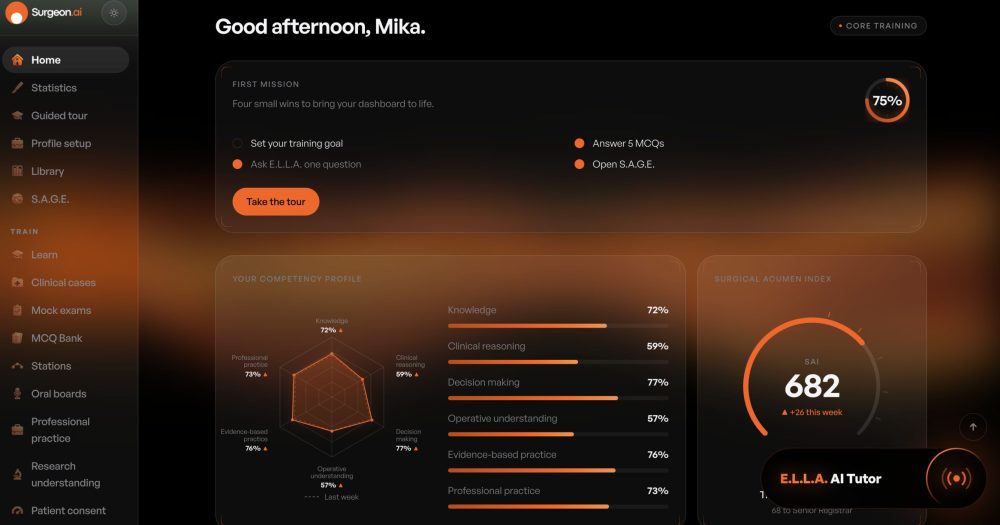
Talent is distributed globally. Opportunity is not. That observation, from Professor Shafi Ahmed, is also the founding logic behind his new platform, Surgeon.AI, which launched this week at the Sir Peter Freyer Memorial Lecture in Galway. For surgeons training in under-resourced health systems, or simply without access to the right mentors, it's a problem that shapes entire careers. Ahmed, a surgeon and healthcare technology innovator with a track record in virtual reality and livestreamed operations, is now betting that artificial intelligence can close that gap in ways previous technologies could not.
At the centre of Surgeon.AI is ELLA, the Education, Learning and Language Agent. ELLA is an AI companion built specifically for surgical learners, designed to support personalised questioning, explanation and reflection throughout a surgeon's training. It is not a chatbot bolted onto a database. The platform has been built, according to Ahmed, by surgeons, for surgeons, with the intention that it grows more useful the longer a surgeon uses it.
How does it work?
ELLA sits within a broader architecture of three connected systems:
- SurgeonOS, an intelligent learning environment covering surgical knowledge, examination preparation, clinical learning and professional development.
- SurgeonGPS, a career navigation system that helps surgeons understand where they are in their professional journey and what to focus on next.
- SurgeonIE, an intelligence engine connecting surgeons to education, mentorship, innovation and collaboration opportunities beyond their immediate institution.
Running across all of this is the Surgical Acumen Index, or SAI. It is a proprietary algorithm that tracks a surgeon's development not through exam scores alone, but across six dimensions: knowledge, clinical reasoning, decision making, operative understanding, evidence-based practice and professional practice. The SAI is not a credentialing tool. It does not replace formal examinations or competency assessments. But it is designed to give surgeons, and potentially their trainers, a more detailed picture of where someone is developing and where the gaps remain.
Why does it matter?
Surgical education has historically been shaped by geography and luck. Where you train, who happens to teach you, which cases land in your hospital. That model produces excellent surgeons in some places and underprepared ones in others, through no fault of the individual. AI-driven personalised learning does not solve every structural problem in surgical training, but it does offer something meaningful: continuity of educational support that does not depend on a single institution or supervisor.
For the GCC, this is directly relevant. Saudi Arabia's Vision 2030 health strategy and the UAE's wider push to develop local clinical talent both depend on producing well-trained, globally competitive medical professionals. Platforms that support examination preparation and career development independently of geography fit neatly into that agenda. Several GCC health authorities have already shown appetite for AI in clinical education, and tools like Surgeon.AI could find a ready market among national training programmes looking to supplement existing infrastructure.
The context
Ahmed is not a new name in this space. He has spent years experimenting with technology in surgical education, from streaming live operations to using virtual reality in training environments. Surgeon.AI is his most ambitious project to date, and the one most likely to scale. The initial focus is surgical trainees preparing for examinations, with plans to expand across specialties, training systems and countries over time.
But the longer-term picture is broader. The platform is designed to support surgeons from the first years of medical school through to specialist development and lifelong learning. If the SAI works as intended, it could eventually offer a continuous, evolving record of a surgeon's intellectual and clinical development. That's a different proposition from anything currently available, and one that health systems, training bodies and perhaps insurers may one day find useful. For now, the question is whether surgeons will actually use it.
Latest @
Blueprint lands in the UAE as longevity moves from policy to product
M42 launches 10,000-patient wearable pilot in Abu Dhabi to reshape chronic disease care
Unilabs Middle East and Takalam link diagnostics to mental health in one app
Al Ghurair enters healthcare with Trellis Health launch in Dubai
💡Did you know?
You can take your DHArab experience to the next level with our Premium Membership.👉 Click here to learn more
🛠️Featured tool
 Easy-Peasy
An all-in-one AI tool offering the ability to build no-code AI Bots, create articles & social media posts, convert text into natural speech in 40+ languages, create and edit images, generate videos, and more.
👉 Click here to learn more
