

Sidra Medicine gives Qatar its first Itvisma gene therapy, making history for SMA care
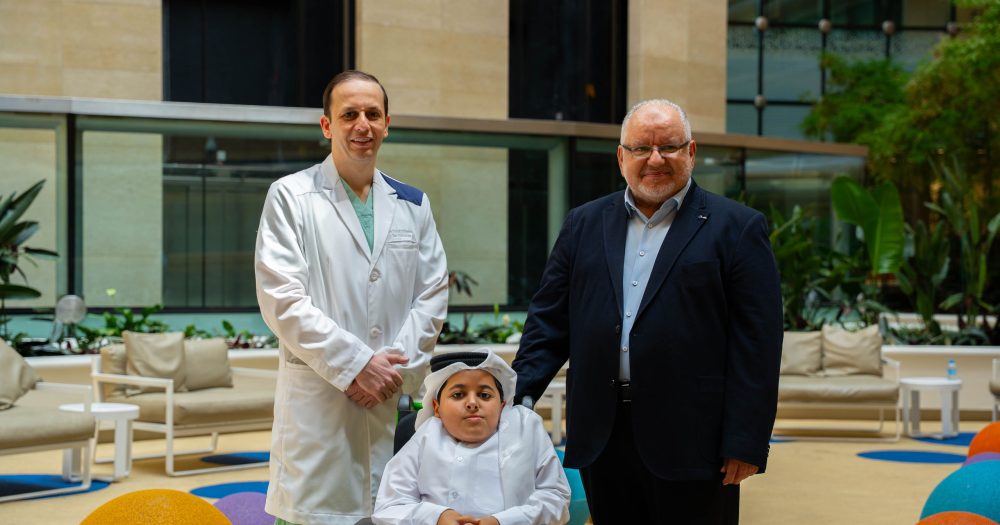
Khalid wants to take his mother to Makkah. That is the first thing the 13-year-old said after becoming the first patient in Qatar to receive Itvisma, a one-time gene replacement therapy for spinal muscular atrophy. It is a small, human detail in a story that carries significant weight for rare disease care across the region.
Sidra Medicine, a member of Qatar Foundation, administered the therapy in Doha on 28 July 2026, making it the first hospital in Qatar to do so and placing Qatar third in the world to use Itvisma. For a country that has invested heavily in precision medicine as part of its broader national health strategy, the milestone is meaningful. But for Khalid's family, who spent years traveling internationally in search of answers, it means something more personal: advanced care, finally, at home.
How does it work?
Spinal muscular atrophy is a rare genetic neuromuscular disease caused by a missing or non-functioning SMN1 gene. Without it, the body cannot produce enough survival motor neuron protein, which is essential for motor neuron health and muscle function. Over time, the disease progressively weakens the muscles.
Itvisma, known generically as onasemnogene abeparvovec, addresses the root genetic cause. It delivers a functional copy of the human SMN1 gene through a single intrathecal injection, meaning it is administered directly into the spinal canal. This is not a treatment patients repeat. It is given once.
At Sidra Medicine, delivering that single injection required months of preparation and coordination across more than ten specialties, including:
- Genetics and Genomic Medicine
- Interventional Radiology
- Neurology and Anesthesiology
- Pediatric Intensive Care and Pulmonology
- Pharmacy, Physiotherapy, and Orthopedic Spine Services
Because Khalid has severe scoliosis, a common complication in SMA patients, the clinical team used real-time imaging during the procedure to guide needle placement with precision. Dr. Walid Mubarak, Senior Attending Physician in Interventional Radiology at Sidra Medicine, described the approach as critical: accurate delivery, in a complex anatomy, with no margin for error.
Why does it matter?
For years, SMA was managed rather than treated. Physicians focused on slowing progression and supporting function. Gene therapy changes that equation by targeting the disease at its source, not its symptoms.
Prof. Tawfeg Ben Omran, Division Chief of Genetics and Genomic Medicine at Sidra Medicine, noted that using interventional radiology for this kind of precision delivery places the hospital among the first pediatric centers in the world to adopt the approach, particularly for patients with complex spinal anatomy. That is not a minor distinction. SMA patients with severe scoliosis have historically faced barriers to intrathecal delivery, and Sidra's capacity to manage that complexity opens the therapy to a broader patient group.
Itvisma is now registered with Qatar's Ministry of Public Health, which means eligible patients can access it locally following specialist assessment. That matters in practical terms. Families no longer need to travel abroad for a therapy that, until now, was simply not available here.
The context
Qatar's investment in genomic and precision medicine has been building steadily, anchored by institutions like Sidra Medicine and supported through the Qatar National Research Strategy. This administration of Itvisma is one visible output of that longer investment.
Across the Gulf, the picture is similar. Saudi Arabia's Vision 2030 places health transformation at the center of national reform. The UAE has made genomics and AI-driven diagnostics central to its health system ambitions. Rare disease care, once an afterthought in regional health planning, is increasingly recognized as a marker of system maturity. A health system that can treat SMA with a one-time gene therapy, coordinated across a dozen specialties, under real-time imaging, is not a developing system. It is an advanced one.
Novartis, which produces Itvisma, has signaled continued commitment to expanding access across the GCC. Mohammed Ezz Eldin, Head of the GCC Cluster at Novartis, pointed to the milestone as evidence of what coordinated collaboration between industry and healthcare providers can produce for patients with significant unmet needs.
And Khalid, now recovering and still a high-achieving student at Qatar Academy Sidra, has already set his next goal. He wants to become a doctor to help other children like him. So the story does not end with the injection. It continues.
Latest @
Blueprint lands in the UAE as longevity moves from policy to product
M42 launches 10,000-patient wearable pilot in Abu Dhabi to reshape chronic disease care
Unilabs Middle East and Takalam link diagnostics to mental health in one app
Al Ghurair enters healthcare with Trellis Health launch in Dubai
💡Did you know?
You can take your DHArab experience to the next level with our Premium Membership.👉 Click here to learn more
🛠️Featured tool
 Easy-Peasy
An all-in-one AI tool offering the ability to build no-code AI Bots, create articles & social media posts, convert text into natural speech in 40+ languages, create and edit images, generate videos, and more.
👉 Click here to learn more
