

Samsung Health lowers the barrier to sleep coaching and upgrades its running programs
Poor sleep is a public health problem across the GCC, where late social hours, extreme heat, and long working days push many residents into chronic sleep deficit. So when Samsung updates its sleep coaching tools, it's worth paying attention — not just as a consumer feature, but as a signal of where digital health is heading.
What's new?
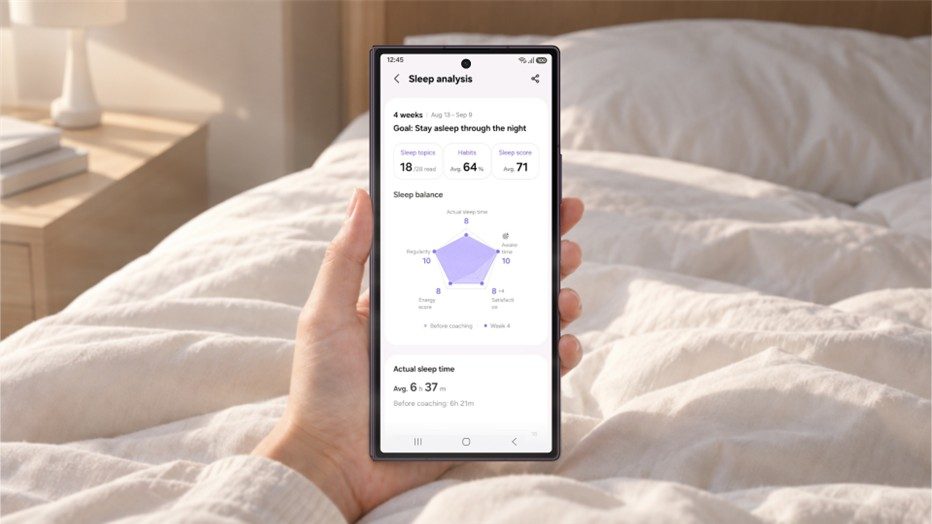
Samsung has updated its Health app with two meaningful changes. First, Sleep Coaching now requires just three days of sleep data collected within the past two weeks, down from seven days in a month. That's a real reduction in friction. Users complete a short survey covering sleep regularity, alcohol and caffeine intake, and subjective satisfaction. The app then assigns a personalised Sleep Animal profile and builds a four-to-eight-week coaching plan, adjusting weekly as habits and sleep patterns shift.
A new pentagon-shaped Sleep Balance graph brings together five indicators — sleep time, regularity, awake time, satisfaction, and Energy Score — into a single view. Daily morning messages tie overnight data to actionable tips, feeding into weekly progress reports.
Second, the Running Coach has expanded from 10 to 12 training tiers, adding structured levels for intermediate and advanced runners. Users can now import Strava Routes directly into Samsung Health for running, trail running, and cycling. A social sharing feature also lets runners export workout data into platform-ready templates.
The update is rolling out from October via Samsung Health app v6.24 or above, paired with Galaxy Watch 4 series and later, Galaxy Fit3, or the Galaxy Ring.
Why does it matter?
Lowering the data threshold to start Sleep Coaching removes one of the most common drop-off points in digital health programs: the waiting period. Most users who try a health app and don't see value within a week stop using it. Three days is a far more realistic hook. The weekly adaptive recommendations also move this beyond simple tracking into something closer to behavioural support, grounded in sleep science principles.
For the GCC, where wearable adoption is rising fast and health ministries are investing in preventive care, tools like this sit squarely within national health goals. Saudi Arabia's Vision 2030 and the UAE's preventive health agenda both emphasise shifting citizens from reactive treatment to proactive wellness. Consumer-grade coaching tools on widely used devices are part of that shift, whether or not they're formally integrated into health systems.
The context
Samsung is not alone in this space. Apple, Fitbit, and Garmin all offer some form of sleep or wellness coaching. But Samsung's combination of hardware, the Galaxy Ring included, and software adaptation gives it a credible platform play. The Strava partnership also matters: Strava has a large and active community in Gulf cities, particularly in Dubai and Riyadh, where running clubs and outdoor fitness culture have grown significantly. Connecting the two platforms reduces the friction of managing multiple apps, which remains one of the biggest barriers to sustained health behaviour change.
Latest @
Google Fitbit Edge: A serious fitness tracker that refuses to be a smartwatch
Google and Flo Health join forces on women's health data
Samsung Health lowers the barrier to sleep coaching and upgrades its running programs
Fifteen years of digital health in the U.S.: What $140B and a crystal anniversary can teach us
💡Did you know?
You can take your DHArab experience to the next level with our Premium Membership.👉 Click here to learn more
🛠️Featured tool
 Easy-Peasy
An all-in-one AI tool offering the ability to build no-code AI Bots, create articles & social media posts, convert text into natural speech in 40+ languages, create and edit images, generate videos, and more.
👉 Click here to learn more
