

Qatar opens genome education toolkit to the world
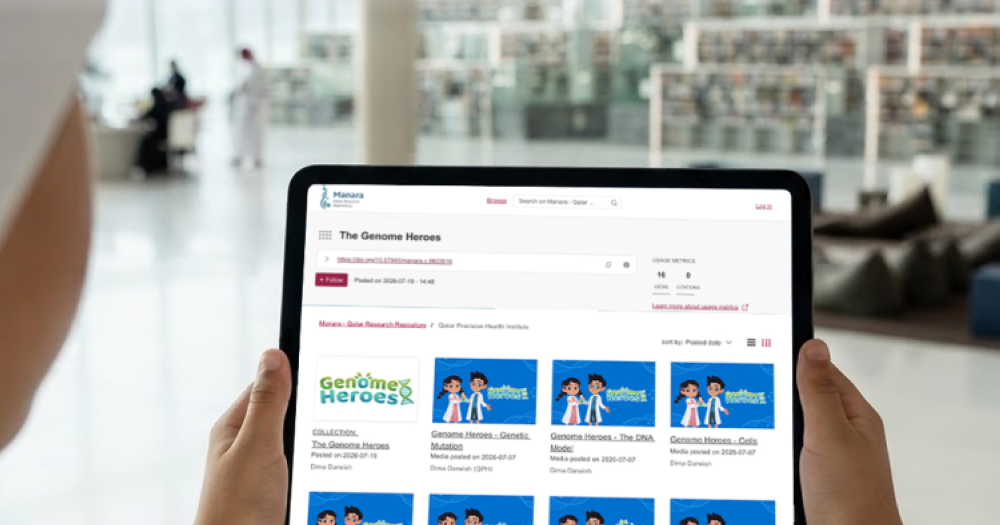
Most genomics education programs struggle to reach beyond the institutions that created them. Qatar's Genome Heroes is now doing the opposite. The Qatar Precision Health Institute (QPHI), operating under Qatar Foundation, has partnered with Qatar National Library (QNL) to publish its full suite of genomics learning materials on Manara, QNL's open-access digital repository, making the content available to anyone in the world at no cost.
The materials target children aged 6 to 14 and were originally developed as part of an interactive mobile game designed to introduce the basics of genetics in an accessible, age-appropriate way. The game was tested at Qatar Academy, a Qatar Foundation school, before the broader educational ecosystem was built around it.
That ecosystem has grown considerably. What began as a mobile application has become a structured teaching toolkit, and it is this expanded collection that is now live on Manara.
How does it work?
The open-access collection published on Manara includes two main content types:
- Bilingual educational magazines available in both Arabic and English, featuring short stories that connect genome science to everyday life, alongside interactive games that introduce core terminology
- Animated educational episodes produced in Arabic and English, using characters from the original game, including Dana, Hamad, and the Professor, to explain genetic concepts through short animated stories
By hosting the files on Manara, each item receives a permanent digital object identifier, or DOI. That means the materials are citable, indexed, and preserved for long-term academic and public use. The mobile game itself remains available separately on the Apple Store and Google Play in both languages.
Why does it matter?
Dima Darwish, Education and Training Manager at QPHI, put it plainly: "Our mission at QPHI extends beyond the laboratory. Partnering with Qatar National Library allows us to transcend geographical boundaries. It transforms our localised success into a permanent, global public good where anyone, anywhere, can access this foundational knowledge."
That framing matters. Precision medicine as a field is only useful if future clinicians, researchers, and policymakers understand what it is. Building that understanding has to start early, and it has to start in schools. Arabic-language genomics education at this level is still relatively rare, which makes the bilingual format a practical contribution, not just a symbolic one.
For educators and parents in countries where genomics is not yet part of the standard curriculum, freely available, professionally produced, and peer-tested materials are genuinely hard to come by. This fills a real gap.
The context
The move fits neatly within Qatar National Vision 2030, which sets out a clear ambition to shift Qatar's economy toward knowledge creation and research. Open-access publishing is one of the more concrete ways research institutions demonstrate that commitment, and the use of DOIs adds a layer of academic credibility that distinguishes this from a simple content release.
Across the GCC, health and education ministries have been investing heavily in science literacy programs, partly to support the pipeline of local talent that national health strategies depend on. Saudi Vision 2030 and the UAE's various science and innovation agendas share a similar logic: long-term health system resilience requires homegrown expertise, and that expertise starts with early education.
So a children's genomics program published in Doha, freely downloadable in Arabic and English, with DOIs and global reach, is a small but meaningful piece of a much larger regional effort. The full collection is available now at the Manara QPHI Research Repository Portal.
Latest @
Blueprint lands in the UAE as longevity moves from policy to product
M42 launches 10,000-patient wearable pilot in Abu Dhabi to reshape chronic disease care
Unilabs Middle East and Takalam link diagnostics to mental health in one app
Al Ghurair enters healthcare with Trellis Health launch in Dubai
💡Did you know?
You can take your DHArab experience to the next level with our Premium Membership.👉 Click here to learn more
🛠️Featured tool
 Easy-Peasy
An all-in-one AI tool offering the ability to build no-code AI Bots, create articles & social media posts, convert text into natural speech in 40+ languages, create and edit images, generate videos, and more.
👉 Click here to learn more
