

Fifteen years of digital health in the U.S.: What $140B and a crystal anniversary can teach us
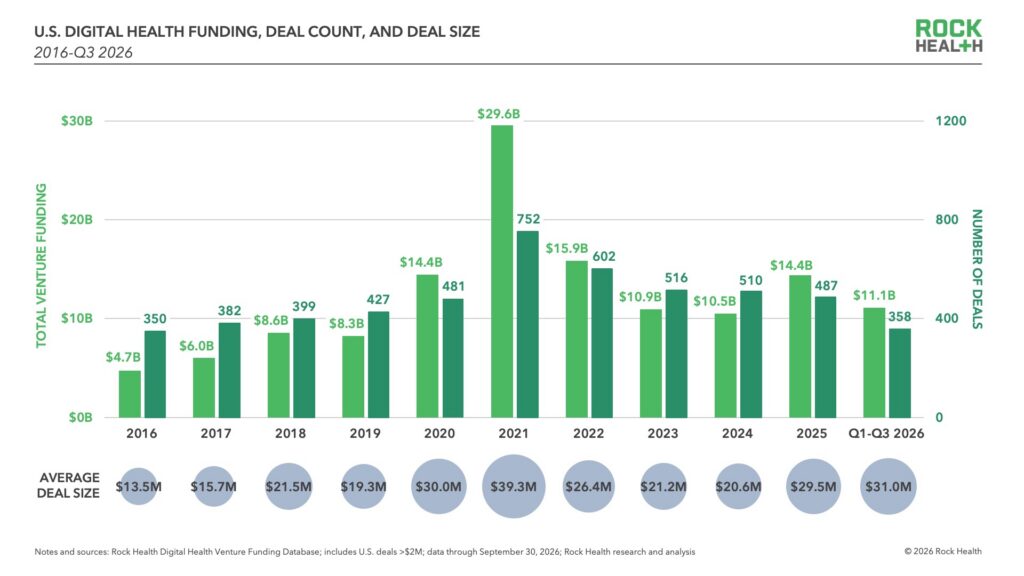
In 2011, Rock Health counted just 35 venture-backed digital health companies in the United States. Today, that number exceeds 3,200. If 2026's funding pace holds, the sector will close the year at roughly $14.8B in venture capital. That is twelve times what was raised fifteen years ago. So the question worth asking is not whether digital health has grown. It clearly has. The question is whether it has grown into something that works.
Rock Health's Q3 2026 market update, released on the week of the firm's 15th annual Summit, attempts to answer that. It is part quarterly data report, part anniversary reflection, and part honest reckoning with what remains unfinished. The firm calls this the "crystal anniversary," a reference to the traditional 15-year gift symbolising clarity and strength. The framing is deliberate. Fifteen years of data and deal flow should, in theory, produce clarity. What the report shows is that it mostly does, with some important caveats.
Highlights
- U.S.-based digital health startups raised $3.7B across 114 deals in Q3 2026, bringing the year-to-date total to $11.1B across 358 deals
- Average deal size climbed to $31.0M in 2026, up from $29.5M in 2025 and $20.6M in 2024, reflecting continued concentration in larger cheques
- The M&A market logged 45 deals in Q3, bringing the year-to-date total to 164, broadly in line with 2025's pace of 172 through the same period
- Public markets remain quiet, with no new listings since HeartFlow in August 2025, though a postponed IPO signals some appetite is returning
- The sector has collectively raised over $140B since 2011, and nearly half of American adults now own a wearable device
Why does it matter?
The capital concentration story is one that GCC health investors and policymakers should watch closely. Bigger cheques going to fewer companies is not a sign of a contracting market. It is a sign of a maturing one. Early-stage bets are becoming harder to justify without clinical evidence, clear reimbursement pathways, or enterprise contracts already in place. That shift mirrors what health authorities in Saudi Arabia and the UAE have been pushing for domestically: less enthusiasm for digitisation as a concept, and more accountability for outcomes.
Rock Health's retrospective is also a useful corrective to the uncritical optimism that tends to surround health technology. The report's contributors, founders and investors who have been in the sector since the beginning, are candid about the early mistakes. The first wave of digital health, they note, largely put existing healthcare processes on a screen and called it innovation. E-visits. Digital front doors. Automating the physician-patient relationship in ways that patients did not actually want. The sector has learned, slowly, that removing administrative waste is where technology adds real value, not replacing the clinical encounter itself.
That lesson is directly relevant to ongoing digitalisation efforts across the GCC. Saudi Arabia's Vision 2030 health targets and the UAE's unified health platform ambitions are both predicated on technology improving access and efficiency. But the risk of digitising bureaucracy rather than transforming care delivery is real, and the American experience over fifteen years offers a useful map of which mistakes to avoid.
The context
Rock Health launched in early 2011 with the conviction that technology could improve healthcare. At the time, only 2% of early-stage digital health entrepreneurs reported securing venture capital, and 84% were bootstrapped. Healthcare funds did not fully understand technology, and technology funds did not fully understand healthcare. Founders had to explain what digital health even was before they could pitch their own companies.
What changed the trajectory was a combination of policy shifts, new reimbursement codes that created reliable revenue paths, and, unexpectedly, the COVID-19 pandemic. Telehealth adoption that might have taken a decade happened in months. But the report is careful not to treat the pandemic as a clean win. It opened doors while also exposing how fragile some of those gains were once restrictions lifted.
The exit environment has stabilised relative to the 2021 peak, but the public market remains cautious. With no new digital health listings since mid-2025, IPO windows have not yet reopened in a meaningful way. M&A remains the dominant exit path, which suggests acquirers, largely health systems, insurers, and large technology companies, are still consolidating rather than the market producing a new generation of standalone public companies.
For the GCC, where sovereign health funds and government-linked entities are increasingly active in health technology investment, the structural lessons from fifteen years of American digital health are worth studying carefully. Capital alone does not build a functioning ecosystem. It takes buyers willing to adopt, regulators willing to move, and founders willing to build for clinical value rather than investor narratives. Rock Health's anniversary report is a reminder that all three remain works in progress, even in the world's most heavily funded health technology market.
Latest @
Google Fitbit Edge: A serious fitness tracker that refuses to be a smartwatch
Google and Flo Health join forces on women's health data
Samsung Health lowers the barrier to sleep coaching and upgrades its running programs
Fifteen years of digital health in the U.S.: What $140B and a crystal anniversary can teach us
💡Did you know?
You can take your DHArab experience to the next level with our Premium Membership.👉 Click here to learn more
🛠️Featured tool
 Easy-Peasy
An all-in-one AI tool offering the ability to build no-code AI Bots, create articles & social media posts, convert text into natural speech in 40+ languages, create and edit images, generate videos, and more.
👉 Click here to learn more
