

Bristol Myers Squibb builds life science’s most powerful AI cluster on NVIDIA Vera Rubin
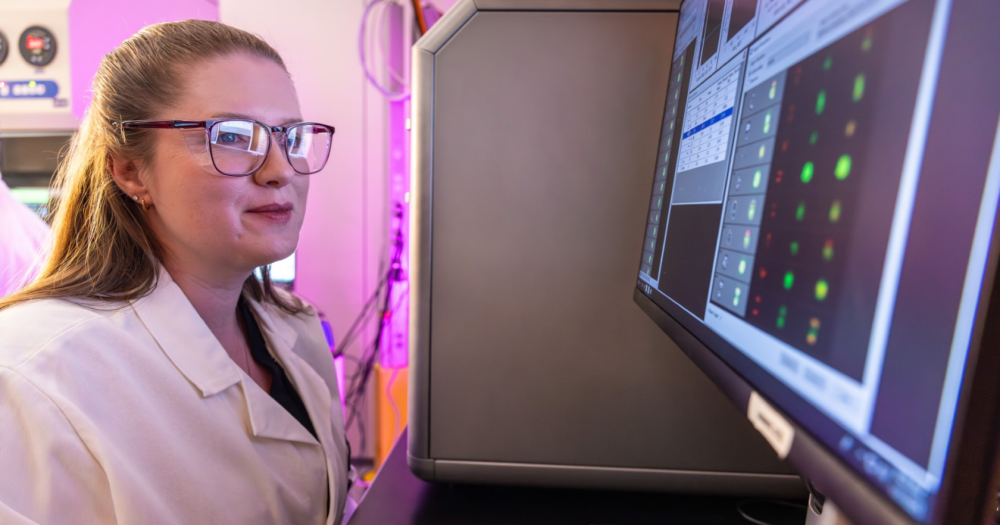
When Bristol Myers Squibb's vice president of research technology Erin Davis describes the company's new AI system, she calls it the "SuperDuperPOD." It's a playful name for something serious: a second NVIDIA DGX SuperPOD, built on eight DGX Vera Rubin NVL72 systems, that delivers up to ten times the performance per megawatt of the infrastructure it replaces. BMS says this makes it the most powerful and energy-efficient AI cluster in life sciences today.
The announcement matters because BMS is not starting from scratch. The company has operated an earlier DGX SuperPOD for roughly three years and has already produced measurable results: AI-assisted target identification that saves scientists weeks of manual work, an expanded library of CELMoD compounds engineered to degrade cancer-causing proteins, and a methodology called "Predict First" that uses computational models to screen molecules before any lab synthesis begins. The new system is not an experiment. It's a scaling decision.
"We're saturated," Davis says. "We're in production with some very large-scale predictions around large molecules. We're building our own foundational models, and that takes a lot of GPUs."
Payal Sheth, senior vice president of therapeutic discovery sciences at BMS, puts the broader goal plainly: moving from "this abstract position of what AI can do to actually translating that to measurable impact." That framing will be familiar to health system leaders across the GCC, where governments have invested heavily in digital health infrastructure but are now demanding proof of clinical and operational returns.
How does it work?
The eight rack-scale systems each pair NVIDIA Vera CPUs with Rubin GPUs. Together, they will give BMS researchers access to a unified AI platform that includes the NVIDIA BioNeMo Agent Toolkit, a suite built for biological AI applications. Davis's team is combining the new system with the existing SuperPOD into a single data environment accessible from every BMS site globally.
That matters as much as the raw compute. Previously, site-specific access restrictions left over from past acquisitions meant many researchers simply couldn't reach the infrastructure. The new setup is managed through NVIDIA Mission Control, and researchers will be able to initiate complex predictions in plain English rather than needing deep computational expertise.
The practical workflow now includes:
- AI-enabled target identification to reduce weeks of manual screening
- Expansion of chemical compound libraries using predictive design
- Multi-parameter molecular optimization before lab synthesis begins
- Agentic workflows that draw on data across programs and therapeutic areas
- A unified data plane that allows learnings from one site to feed models used at another
"Datasets from a program run in Lawrenceville, New Jersey, feed models that a team in San Diego can draw on," Sheth explains. Every experiment, clinical readout, and research partnership compounds into what she describes as a cumulative learning loop, one that simply didn't exist at the start of her career.
Why does it matter?
Drug discovery is expensive, slow, and heavily skewed toward failure. The average molecule takes more than a decade to move from identification to approval, and most never make it. Any infrastructure that shortens early-stage cycles or improves the odds of selecting the right molecules has real financial and human consequences.
But the BMS approach also signals something about how large pharmaceutical organisations are thinking about AI access. Rather than concentrating compute among a specialist team, Davis's pitch is the opposite. "Instead of equipping a small group of researchers with access to the supercomputer, we're opening it up to literally every scientist," she says. "No one has to wait, and no one is told they have a limit."
That model has direct relevance for health systems in the Gulf that are building research capacity alongside clinical infrastructure. Saudi Arabia's Vision 2030 health strategy and the UAE's national AI agenda both call for translating digital investment into tangible outcomes. The question BMS is answering, at scale, is what it actually looks like when AI compute is treated as a shared scientific resource rather than a specialist tool.
The context
Davis came to her role after 15 years on the vendor side, building enterprise platforms at ChemAxon, Schrödinger, and X-Chem. Her conclusion across those companies was consistent: the technology was rarely the problem. Getting it into the hands of working scientists was. Her father's death from Alzheimer's five years ago has given that mission a personal dimension. BMS has a significant research investment in brain health, one of the hardest therapeutic areas in medicine.
Sheth is careful to frame AI's role correctly. Human instincts, she says, are not replaced, "they're augmented with more quantitative insights and predictions." Davis agrees, but is clear about what the scale of compute changes. "This takes up the capabilities of individual humans substantially," she says. When BMS's chief digital officer asked Davis whether she was confident the new system could even be fully used, her answer was short: "Just give us time."
Latest @
Blueprint lands in the UAE as longevity moves from policy to product
M42 launches 10,000-patient wearable pilot in Abu Dhabi to reshape chronic disease care
Unilabs Middle East and Takalam link diagnostics to mental health in one app
Al Ghurair enters healthcare with Trellis Health launch in Dubai
💡Did you know?
You can take your DHArab experience to the next level with our Premium Membership.👉 Click here to learn more
🛠️Featured tool
 Easy-Peasy
An all-in-one AI tool offering the ability to build no-code AI Bots, create articles & social media posts, convert text into natural speech in 40+ languages, create and edit images, generate videos, and more.
👉 Click here to learn more
