

Alameda Healthcare and RoboMasters sign EGP 70 million robotic surgery deal in Egypt
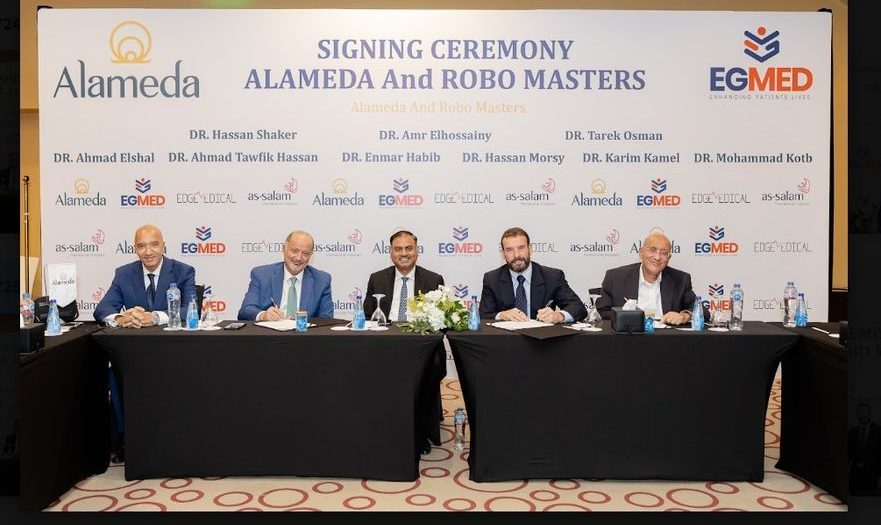
Egypt is spending serious money on robotic surgery. Alameda Healthcare Group, the country's leading private hospital operator, has signed a formal collaboration agreement with RoboMasters, a collective of specialist surgeons working across robotic urology, gynaecology, and general surgery. The deal is backed by an investment of more than EGP 70 million and is set to significantly expand access to robotic-assisted procedures across Alameda's network of facilities in Greater Cairo.
The signing took place at The Westin Cairo Golf Resort and Spa, Katameya Dunes, with senior leadership from both sides in attendance. Dr. Fahad Khater, Chairman of Alameda Healthcare Group, and Neeraj Mishra, Group CEO, represented Alameda. Nine specialist surgeons from RoboMasters were also present, reflecting the breadth of clinical expertise the group brings to the table.
The partnership will use Edge Medical's robotic surgery platform, combining the technology with RoboMasters' surgical expertise across multiple specialties. The goal is to improve surgical precision, extend minimally invasive capabilities, and give Egyptian patients broader access to procedures that, until recently, were largely available only through medical travel abroad.
How will it work?
RoboMasters is not a single clinic or hospital. It is a structured group of surgeons who specialise in robotic techniques across urology, gynaecology, and general surgery. Under this agreement, they will work within Alameda's existing infrastructure to build out comprehensive robotic surgery programs. The collaboration also covers clinical training, which means the long-term aim is to grow local surgical expertise, not simply import it.
Alameda currently operates four JCI-accredited hospitals across Greater Cairo, including as-Salam International Hospital in Maadi, ASSIH New Cairo, Dar Al Fouad Nasr City, and Dar Al Fouad 6th of October City. The group also runs outpatient and rehabilitation facilities. That network gives the partnership real reach. Robotic surgery will not be confined to a single site.
Why does it matter?
Minimally invasive surgery reduces hospital stays, lowers infection risk, and typically shortens recovery times. But robotic-assisted procedures require significant capital investment and trained surgical teams, which is why adoption across the region has been uneven. This deal addresses both barriers at once, pairing the hardware investment with a ready-made team of experienced robotic surgeons.
Speaking at the signing, Mishra said the partnership reflects Alameda's wider commitment to clinical innovation and to raising surgical standards in Egypt and the broader region. That framing matters. Egypt has the population and the healthcare demand to support serious investment in advanced surgical technology, and deals like this one signal that private operators are prepared to move beyond incremental upgrades.
The context
Robotic surgery adoption across the Arab world has accelerated in recent years, driven by Vision 2030 in Saudi Arabia and the UAE's ongoing push to become a regional medical hub. Egypt, with a population of over 100 million, has its own healthcare reform agenda, and the private sector is increasingly central to delivering on it. Alameda's JCI accreditation across its hospital network already places it at the top end of the Egyptian market. Adding a structured robotic surgery program strengthens that position and puts the group in direct competition with the more advanced surgical offerings available in the Gulf. For patients, that competition is exactly what drives quality up.
Latest @
Alameda Healthcare and RoboMasters sign EGP 70 million robotic surgery deal in Egypt
UAE researchers use AI to identify new drug class for blood cancer treatment
Tawam Hospital performs complex colorectal cancer surgery on 81-year-old high-risk patient
Saudi Arabia's Global Health Exhibition returns in 2026 with record ambitions
KFSH and Oracle Health to build a unified clinical and genomic data ecosystem in Saudi Arabia
💡Did you know?
You can take your DHArab experience to the next level with our Premium Membership.👉 Click here to learn more
🛠️Featured tool
 Easy-Peasy
An all-in-one AI tool offering the ability to build no-code AI Bots, create articles & social media posts, convert text into natural speech in 40+ languages, create and edit images, generate videos, and more.
👉 Click here to learn more
