

A violin teacher’s two hernias, one keyhole operation in Fujairah
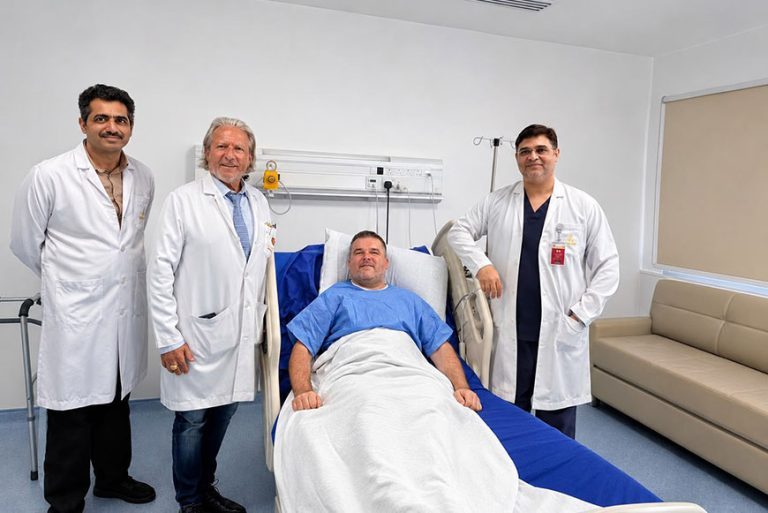
Most hernia repairs are routine. This one was a first. At Thumbay Hospital Fujairah, a surgeon fixed two separate hernias in a single keyhole procedure, and the patient was expected to go home the next morning.
The operation was a Laparoscopic Totally Extraperitoneal (TEP) inguinal hernia repair using balloon dissection, combined with an umbilical hernia repair. Dr. Laurent Leyani, Consultant Bariatric and Laparoscopic Surgeon, led the team. It is the first time the hospital has done this particular technique.
The patient was an Italian violin teacher in his 50s. He had lived with left groin pain for a long time, also had an umbilical hernia, and came to Fujairah for a second opinion.
How did it work?
TEP is a demanding approach. The surgeon works in the thin space between the abdominal wall muscles and the peritoneum, the membrane lining the abdominal cavity. That means the instruments never enter the abdominal cavity itself, which is one reason surgeons favour it for groin hernias.
Creating that working space is the hard part. Dr. Leyani used a balloon space-maker, an inflatable device that gently opens the plane so the surgeon can see and operate. He then repaired the defect with soft mesh fixation, and addressed the umbilical hernia in the same sitting.
One anaesthetic, a few small incisions, two problems solved. The hospital expected the patient to be discharged the next morning.
Why does it matter?
For the patient, it means less time in hospital and, in general, less pain and a quicker return to normal life than open surgery. For a musician who relies on posture and steady hands, that counts.
For Fujairah, it matters for a different reason. Complex laparoscopic work has traditionally clustered in Dubai and Abu Dhabi. When an emirate on the east coast can offer it, residents have less reason to travel for advanced care.
Akbar Moideen Thumbay, Vice President of Healthcare Division at Thumbay Group, said the milestone reflects the group's "continued investment in bringing advanced healthcare services closer to the community." That is a claim worth watching, but a first case is a start, not a track record.
The context
The UAE has spent years pushing for more even access to specialist care across all seven emirates, and the private sector now carries a large share of that effort. Across the GCC, national strategies, including Saudi Vision 2030, put weight on quality, regional access and shorter hospital stays. Minimally invasive surgery fits all three.
Medical tourism is part of the picture too. This patient was a foreign resident looking for a second opinion, and he found it locally. Gulf health systems want to keep that kind of demand at home.
The real test comes next. One successful case shows capability. Repeating it safely, case after case, with consistent outcomes, is what builds trust. Hospital leaders and regulators elsewhere in the Gulf will be looking for that kind of volume and data, not only for announcements.
Latest @
Abu Dhabi freezes a nerve to calm MS spasticity, a first for the UAE
Cambridge Health Group and Heriot-Watt University join forces on rehabilitation research
Khalifa University and Sanofi turn to the genome to understand asthma and COPD in the Gulf
Abu Dhabi puts an AI assistant inside every physician's patient record
ADCAN Pharma and M42 sign MoU to build up UAE drug manufacturing and clinical research
💡Did you know?
You can take your DHArab experience to the next level with our Premium Membership.👉 Click here to learn more
🛠️Featured tool
 Easy-Peasy
An all-in-one AI tool offering the ability to build no-code AI Bots, create articles & social media posts, convert text into natural speech in 40+ languages, create and edit images, generate videos, and more.
👉 Click here to learn more
