

A Dubai-based startup just emerged from stealth to build the future of brain monitoring
Every few years, a technology comes along that makes you wonder why it took this long. Continuous glucose monitors made blood sugar trackable outside the lab. Wearable ECGs brought cardiac monitoring to your wrist. Each time, the shift followed the same pattern: something that once required a clinical visit became something you could measure in your daily life — and that changed how conditions were caught, managed, and treated.
Brain health hasn't had that moment yet. But a new startup thinks it's time.
What's the News?
Affaan Shaikh, an entrepreneur and applied researcher working at the crossroads of AI and neuroscience whom we've interviewed a year ago, has officially launched Neuratia Labs — a neurotechnology company with bases in Dubai and Mumbai. After operating in stealth, the company has come out publicly with a clear mission: make continuous, real-time brain monitoring as normal as tracking your heart rate or blood pressure.

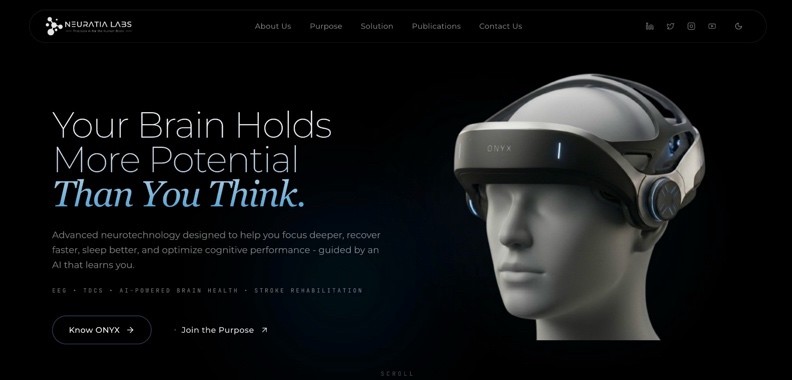
At the center of its product roadmap is ONYX, a non-invasive, head-worn EEG device paired with software that reads neural signals and translates them into understandable metrics — things like stress levels, cognitive fatigue, and attention quality. What sets Neuratia Labs apart from many existing solutions is where they're heading next: a closed-loop system that doesn't just measure brain activity, but responds to it. Think of it as a brain monitor that can also nudge the brain back toward healthier patterns, automatically and in real time.
The company is currently in prototype development, with pilot studies and early clinical partnerships in the works.
Why Does It Matter?
Here's a striking reality: we live in an era where a smartwatch can detect an irregular heartbeat or estimate your blood oxygen, yet brain health is still largely assessed the old-fashioned way — a patient describes their symptoms, a clinician makes a judgment call, and monitoring happens maybe once every few months in a clinical setting. For conditions like depression, cognitive decline, or neurological disorders, that gap between what's actually happening in the brain and what gets captured in a doctor's office can be enormous.
Neuratia Labs is going after that gap directly. By enabling continuous, objective measurement of brain activity through a wearable device, the platform could give clinicians — and eventually patients themselves — a much richer picture of what's happening neurologically, day to day and in real time.
The company is initially focused on two areas where this kind of data could genuinely change outcomes:
- Mental health and cognitive performance — where continuous brain-state tracking could support earlier detection and more personalized interventions, rather than waiting for someone to deteriorate before adjusting treatment.
- Neuro-rehabilitation — where recovery from strokes, brain injuries, or other neurological events typically happens in clinic but needs to continue at home. Objective monitoring outside hospital walls could make that process far more guided and effective.
The potential here is real. The field of neuromodulation — techniques like transcranial direct current stimulation (tDCS) and transcranial magnetic stimulation (TMS) — is already gaining traction clinically. But most of those systems operate blind, delivering stimulation without continuously measuring how the brain is actually responding. A closed-loop system that can sense, interpret, and adapt in real time would be a meaningful step forward.
The Context
Neuratia Labs is entering a neurotechnology space that's been quietly heating up. Global interest in brain-computer interfaces and neuromodulation has surged over the past few years, driven partly by high-profile ventures like Neuralink — but also by more near-term, non-invasive applications in mental health, cognitive enhancement, and rehabilitation.
The science underpinning Neuratia's approach is grounded in an increasingly accepted view in neuroscience: conditions like depression, fatigue, and cognitive impairment aren't just about one broken region in the brain. They emerge from disrupted communication patterns across neural networks. That makes them hard to detect with a simple scan but potentially trackable with continuous EEG monitoring over time — which is exactly what Neuratia Labs is building toward.
Affaan Shaikh, the founder and CEO, comes with a background that fits the mission. His prior work spans AI research and health-focused AI systems, with academic publications to his name. He's positioning Neuratia Labs not as a pure research exercise, but as a company translating that science into a deployable platform — starting with clinical and rehabilitation settings, with a longer-term view toward broader use.
The Dubai-Mumbai dual base is also worth noting. The UAE has been aggressively building its health-tech ecosystem, and the region is increasingly attracting startups in digital health and medtech. Neuratia Labs choosing Dubai as part of its home base reflects that broader trend of deep-tech ventures finding a foothold in the Gulf.
It's early days — prototype stage, no commercial product yet. But the problem they're solving is real, the science is credible, and the timing aligns with growing momentum in the neurotech space. Worth keeping an eye on.
Latest @
Blueprint lands in the UAE as longevity moves from policy to product
M42 launches 10,000-patient wearable pilot in Abu Dhabi to reshape chronic disease care
Unilabs Middle East and Takalam link diagnostics to mental health in one app
Al Ghurair enters healthcare with Trellis Health launch in Dubai
💡Did you know?
You can take your DHArab experience to the next level with our Premium Membership.👉 Click here to learn more
🛠️Featured tool
 Easy-Peasy
An all-in-one AI tool offering the ability to build no-code AI Bots, create articles & social media posts, convert text into natural speech in 40+ languages, create and edit images, generate videos, and more.
👉 Click here to learn more
