

Dubai Health teaches doctors to build games
Doctors who can code are useful. Doctors who can design a game that changes how patients behave may be more useful still. That is the bet behind a new partnership between Dubai Health and the Abdulla Al Ghurair Foundation (AGF), which puts medical trainees into a game development bootcamp and asks them to solve problems the health system has already identified.
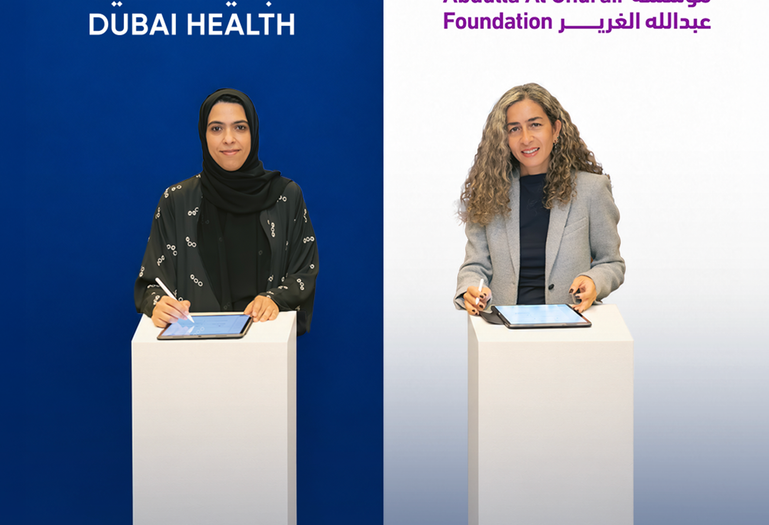
The two organisations have signed an agreement setting out a framework for cooperation in education, capacity building and innovation. It covers joint learning, knowledge sharing, and the use of gamification to give learners the skills to build healthcare solutions. Dr. Hanan Al Suwaidi, Deputy CEO and Chief Academic Officer of Dubai Health and Provost of Mohammed Bin Rashid University of Medicine and Health Sciences (MBRU), signed for Dubai Health. Mona Ghander, Senior Vice President of Innovative Solutions and Strategic Partnerships, signed for AGF.
How will it work?
The first product of the agreement is a 16-week Game Development Bootcamp for Graduate Medical Education trainees at MBRU. Dubai Health and AGF are running it with the United Nations Development Programme Istanbul International Center for Private Sector in Development (UNDP IICPSD) and HP Inc.
Participants will work with mentors from the gaming industry, academic advisors and Dubai Health clinicians. They will build gamified tools aimed at public health priorities set by Dubai Health itself. So the brief does not come from a textbook. It comes from the system the trainees will eventually work in.
Trainees will combine clinical knowledge with game development, design thinking and wider digital skills. The bootcamp is only the start. The agreement also lays the ground for joint research and development, innovation competitions, internships, short courses and workshops, involving faculty, students, staff and clinical teams.
Why does it matter?
Medical training rarely leaves room for product design. This programme makes room for it. Dr. Wail Bamadhaf, Vice Dean of Graduate Medical Education at MBRU, said the future of health will be shaped by professionals who combine clinical knowledge with digital fluency. Ghander made a similar point from the education side, saying digital skills matter most when learners apply them to real challenges.
Gamification is not a gimmick in health. Done well, it can support patient education, prevention campaigns and adherence to treatment. But it only works when clinicians shape the content. That is the gap this bootcamp tries to close, by putting people who understand patients next to people who understand engagement.
The context
The partnership fits a wider pattern across the Gulf. Governments in the GCC want health systems that are digital, preventive and built on local talent, and that goal runs through Saudi Vision 2030, UAE health strategies and national digital transformation plans. Training clinicians to build tools, not only use them, is one practical way to get there.
For AGF, the deal extends its established work on linking education to employment through practical, industry-relevant learning. Healthcare is a new setting for that model, and a demanding one.
Still, the real test comes later. A bootcamp can produce prototypes. What matters is whether any of them reach patients and whether the longer-term framework turns into funded research, internships and lasting programmes. If it does, Dubai Health will have a model other GCC institutions are likely to study closely.
Latest @
Morocco makes it easier to report a bad reaction to a medicine
Dubai Health teaches doctors to build games
Abu Dhabi freezes a nerve to calm MS spasticity, a first for the UAE
Cambridge Health Group and Heriot-Watt University join forces on rehabilitation research
Khalifa University and Sanofi turn to the genome to understand asthma and COPD in the Gulf
💡Did you know?
You can take your DHArab experience to the next level with our Premium Membership.👉 Click here to learn more
🛠️Featured tool
 Easy-Peasy
An all-in-one AI tool offering the ability to build no-code AI Bots, create articles & social media posts, convert text into natural speech in 40+ languages, create and edit images, generate videos, and more.
👉 Click here to learn more
