

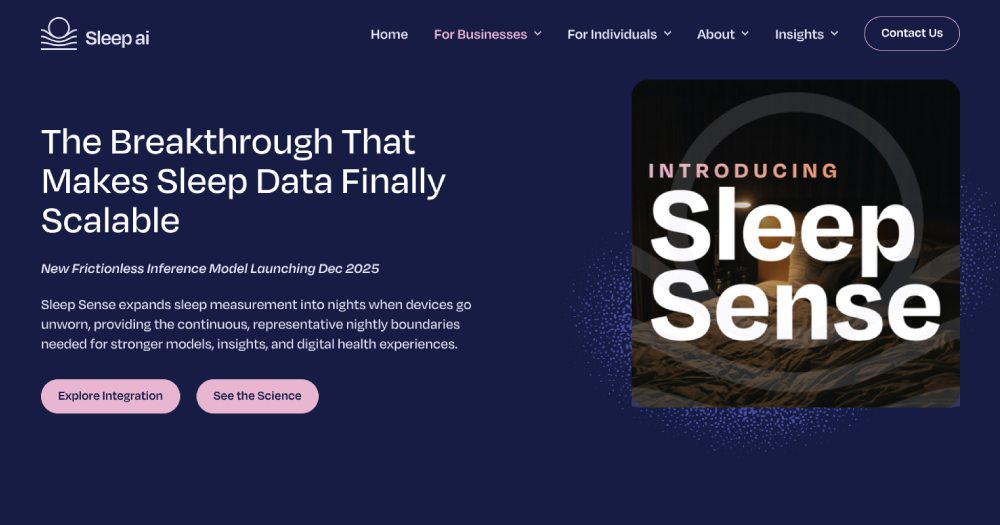
Sleep.ai’s Sleep Sense turns any smartphone into a sleep tracker
For two decades, the health tech industry has circled one stubborn truth. Sleep shapes health more than almost anything else. Yet it remains oddly invisible. Most people do not track it. Most systems do not see it. And most data models work with fragments, not facts.
Sleep.ai says it is time to change that. With the launch of Sleep Sense, the company claims it has turned the most ordinary object in the room into a powerful sleep sensor. Your smartphone. No wristbands. No rings. No nightly rituals. Just sleep, quietly measured in the background.
Colin Lawlor, Founder and CEO of Sleep.ai, puts it plainly. "Sleep Sense is a major step forward for the entire health and wellness ecosystem." His point is simple and hard to argue with. If sleep matters this much, measuring it should not feel like work.
How does it work?
Sleep Sense leans on a mix of advanced artificial intelligence, large scale sleep datasets, and careful system design. The goal is not novelty. It is reliability at scale.
At its core, Sleep Sense uses the smartphone already sitting on a bedside table to infer sleep and wake patterns. It does this without microphones. Without cameras. And without asking the user to lift a finger.
The technology rests on a few key ideas:
- Automatic detection of bedtime and wake time, without setup or daily interaction
- AI boundary detection models that identify sleep transitions with accuracy comparable to clinically validated trackers
- Multimodal analysis that looks at motion, light exposure, and device usage patterns
- Training on datasets that include almost one billion hours of sleep, allowing the system to perform even when signals are messy or incomplete
- A privacy-first architecture that avoids audio recording and meets GDPR and ISO standards
Luke Gahan, Head of Data Science at Sleep.ai, explains the thinking behind it. "The system adapts to each user's natural sleep-wake rhythm, uses multimodal signals to ensure accuracy, and performs reliably across a wide range of devices."
In other words, it works quietly like a good night watch.
Why does it matter?
Because the gap is massive. And costly.
Roughly four billion people wake up tired every week. Yet only about 10 to 15 percent of adults consistently track their sleep using wearables or apps. The rest are flying blind. That blind spot limits personalization. It weakens health programs. And it biases AI models toward the small group willing to wear a device every night.
Sleep Sense aims straight at that problem. By shifting sleep measurement from active tracking to automatic sensing, it opens the door to population-level insight.
For companies, that means real change:
- Personalization that reaches nearly every user, not just the motivated few
- Clearer measurement of program effectiveness and outcomes
- Stronger and less biased AI models
- Lower costs and fewer integration headaches
- New services built on sleep data, without new hardware
Lawlor frames it as a reset. "For years, it is clear that sleep is one of the most powerful predictors and influencers of overall health, yet it has never been measured at scale because it required specific wearables, hardware, or daily user effort. With Sleep Sense, we remove all of that friction."
That friction has always been the villain of digital health. Sleep Sense tries to take it out of the story.
The context
This launch lands at a moment when health platforms are under pressure to prove outcomes, not just promise them. Wearable fatigue is real. Privacy concerns are sharper than ever. And regulators, insurers, and employers want evidence that interventions actually work.
Sleep.ai positions Sleep Sense as infrastructure, not a gadget. It is offered as an API and SDK, ready to plug into health, wellness, insurance, consumer electronics, and digital therapeutics platforms.
Gahan sees it as a long-overdue shift. "For the first time, organizations can access scientifically sound sleep data for nearly their entire user base, which opens the door to more accurate models, better interventions, and truly personalized experiences."
In plain terms, Sleep Sense treats sleep like electricity. Always on. Mostly unnoticed. Absolutely essential.
If the claims hold up, this may mark a quiet but meaningful turn in how sleep enters the data conversation, not as a premium feature for the few - but as a baseline signal for the many.
Latest @
Abu Dhabi launches first UAE clinical trial for gene therapy treating inherited blindness
Mental health platform reaches 600 users in one day across Middle East
Perplexity Health connects all your medical data in one place
Perplexity partners with b.well to give AI health answers using your real medical records
Fitbit's AI coach gets smarter with medical records and sleep tracking
💡Did you know?
You can take your DHArab experience to the next level with our Premium Membership.👉 Click here to learn more
🛠️Featured tool
 Easy-Peasy
An all-in-one AI tool offering the ability to build no-code AI Bots, create articles & social media posts, convert text into natural speech in 40+ languages, create and edit images, generate videos, and more.
👉 Click here to learn more
