

New AI system gives patients 24/7 access to their medical records and doctors
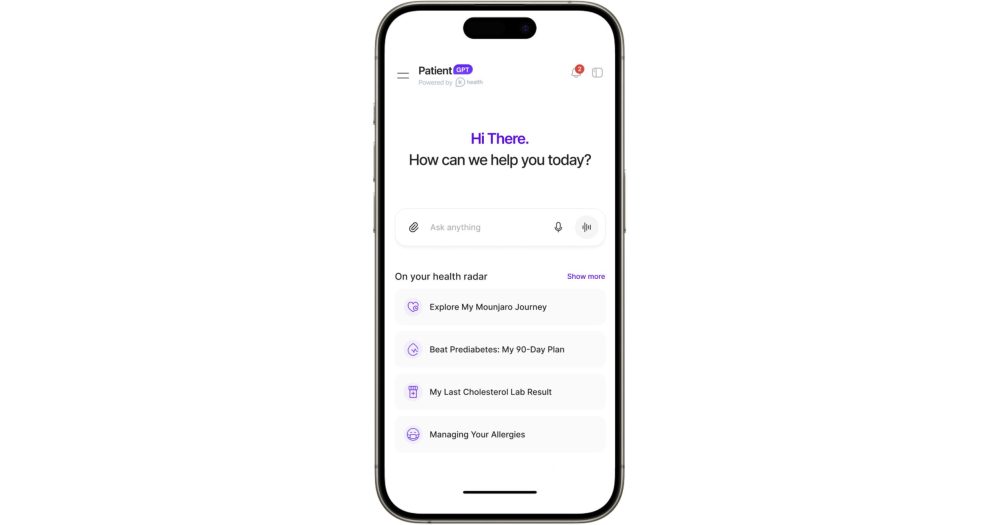
Americans are asking AI for medical advice more than ever. But these conversations happen outside the healthcare system, without access to personal medical records. That means the advice might not apply to your specific situation.
Hartford HealthCare and K Health just launched PatientGPT, an AI system that can securely read your medical records and connect you to a virtual doctor visit. The tool works inside Hartford's patient portal and app, and it's rolling out as a beta test for select patients.
PatientGPT runs 24/7 and gives personalized health education based on your medical data. Unlike consumer AI tools, it can connect you directly to your care team when needed.
How does it work?
PatientGPT uses multiple AI agents working together within secure healthcare infrastructure. When you ask a health question, it:
- Reviews your medical records to give personalized answers
- Asks follow-up questions to understand your situation better
- Connects you to Hartford's 24/7 virtual care if needed
- Schedules in-person appointments with primary care or specialists
- Creates chat summaries for your doctors to review before visits
The system only works for patients 18 and older in Connecticut. It doesn't diagnose conditions or prescribe treatments. When situations are unclear or risky, it sends you to human doctors.
K Health spent nearly a decade building AI that understands medical language - symptoms, medications, treatment options, and the complexity of real health conditions. The system includes safety checks and clinical guidelines to keep responses appropriate.
Why does it matter?
This changes how patients interact with their healthcare system. Instead of waiting for appointments to ask basic questions, you get immediate answers based on your actual medical history.
For doctors, the system handles routine questions and organizes patient concerns before visits. This gives them more time for diagnosis and complex care decisions. Chat summaries help doctors understand what patients are thinking about before they walk in.
"We have to meet people where they are," said Jeff Flaks, Hartford HealthCare's CEO. "PatientGPT supports your health and provides access to a 24/7 care team, while protecting the human relationships at the heart of care."
The tool also prevents the "dead end" problem with standalone health chatbots. When PatientGPT can't help, it connects you directly to real doctors within the same system.
The context
Healthcare AI is moving from experimental to practical. Patients already use AI for health questions, but usually outside their healthcare system. PatientGPT brings that conversation inside, where AI can access your medical records and connect to your doctors.
Hartford HealthCare is introducing PatientGPT gradually, with doctor oversight and quality monitoring. Licensed providers review the system's responses, and multiple AI agents check each other's work to prevent errors.
"Patients are already using AI to manage their lives," said Allon Bloch, K Health's CEO. "The question isn't whether AI will shape healthcare, it's about how we do it safely, inside a health system that connects to your medical records and care team."
K Health partners with major health systems including Cedars-Sinai and Hackensack Meridian Health. The company has raised over $400 million and focuses specifically on primary care AI.
Latest @
Tunisia fast-tracks medicine supply reform with emergency funding
Samsung's Hearapy app claims to prevent motion sickness with 100 Hz sound waves
New AI system gives patients 24/7 access to their medical records and doctors
Samsung Galaxy Watch users can now track blood pressure from their wrist
WHOOP raises $575 million at $10.1 billion valuation with backing from QIA and Mubadala
💡Did you know?
You can take your DHArab experience to the next level with our Premium Membership.👉 Click here to learn more
🛠️Featured tool
 Easy-Peasy
An all-in-one AI tool offering the ability to build no-code AI Bots, create articles & social media posts, convert text into natural speech in 40+ languages, create and edit images, generate videos, and more.
👉 Click here to learn more
