

Mubadala and Khalifa University bet on lab-stage science with new life sciences programme
Most health systems are good at buying innovation. Far fewer are good at producing it. A new partnership in Abu Dhabi is an attempt to close that gap at the earliest and riskiest stage, where ideas are still in the lab and funding is hardest to find.
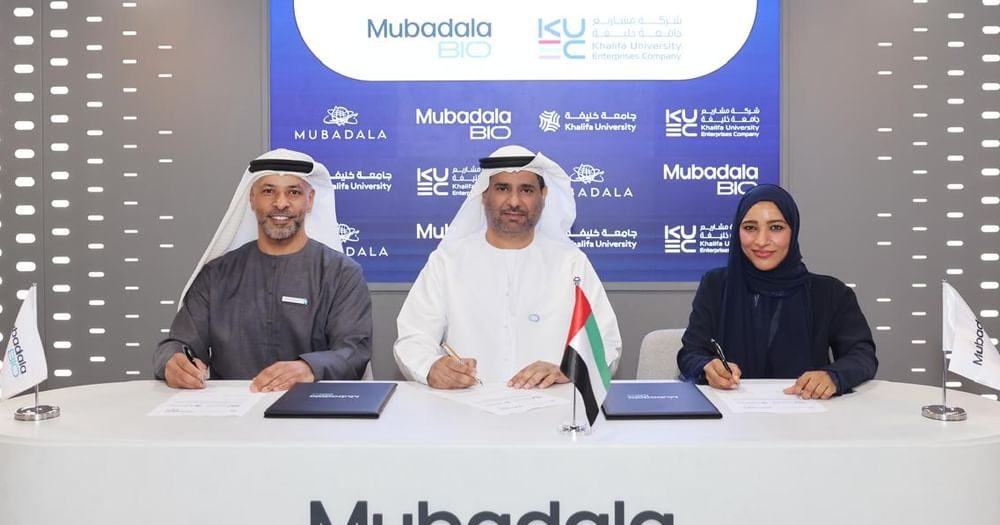
Mubadala Investment Company has launched the Life Sciences Innovation Programme (LSIP) with Khalifa University of Science and Technology. It sits under a strategic research partnership between the two institutions and is designed to strengthen the UAE's healthcare innovation ecosystem. The programme will focus on early-stage research, the point at which promising science most often stalls.
How will it work?
The announcement is short on operational detail, and it is worth saying so. Funding levels, project selection criteria and timelines were not part of the information available at the time of writing. What is clear is the structure. Khalifa University brings research talent, laboratories and academic expertise. Mubadala brings capital, an investor's discipline and a portfolio that already spans healthcare and life sciences.
That pairing matters. Universities tend to measure success in publications, while investors look for products and returns. A programme that sits between the two has to translate one set of priorities into the other. If LSIP does that well, researchers get a route out of the lab, and Mubadala gets earlier sight of science that could become investable.
Why does it matter?
Early-stage research is where the funding gap is widest. Private investors usually wait for proof of concept, and grant money rarely stretches far enough to produce it. Programmes that fund this stage can decide whether a promising idea survives at all.
For healthcare professionals, the long-term benefit is local relevance. Research done in the region can focus on conditions that weigh heavily on Gulf populations, including diabetes, cardiovascular disease and genetic disorders linked to high rates of consanguinity. Imported therapies and diagnostics are not always built with those patients in mind.
For business leaders, the programme signals where Abu Dhabi expects value to come from. Owning hospitals and importing technology is one model. Owning the intellectual property behind the next generation of treatments is another.
The context
This fits a clear pattern. The UAE has spent years building its position in genomics, preventive medicine and health data, and Abu Dhabi has been explicit about wanting a life sciences sector that can compete internationally. Mubadala has been central to that effort through its healthcare investments, including its stake in the health group M42.
The wider Gulf is moving in the same direction. Saudi Arabia's Vision 2030 includes a major push on health sector reform and local biotech capability, and Qatar and Bahrain have their own research and genomics initiatives. Every GCC state is trying to reduce its reliance on imported medical innovation.
So the real test for LSIP is not the launch but the output. Success would look like research projects that become spin-outs, clinical collaborations or licensed technologies, with Emirati institutions retaining a meaningful share of the value. That will take years to judge. But the decision to fund the earliest stage, where the risk is highest, suggests the UAE is serious about building the pipeline and not only buying from it.
Latest @
Neuratia Labs picks CliniDataCue to solve the data problem facing its first research fellows
Robotics comes to the IVF lab as Abu Dhabi's fertility sector eyes automation
American Hospital Dubai to help build an AI billing platform, not just buy one
Mubadala and Khalifa University bet on lab-stage science with new life sciences programme
Abu Dhabi's biobank teams up with AstraZeneca to predict disease before it starts
💡Did you know?
You can take your DHArab experience to the next level with our Premium Membership.👉 Click here to learn more
🛠️Featured tool
 Easy-Peasy
An all-in-one AI tool offering the ability to build no-code AI Bots, create articles & social media posts, convert text into natural speech in 40+ languages, create and edit images, generate videos, and more.
👉 Click here to learn more
