

AI beats doctors in medical showdown in China
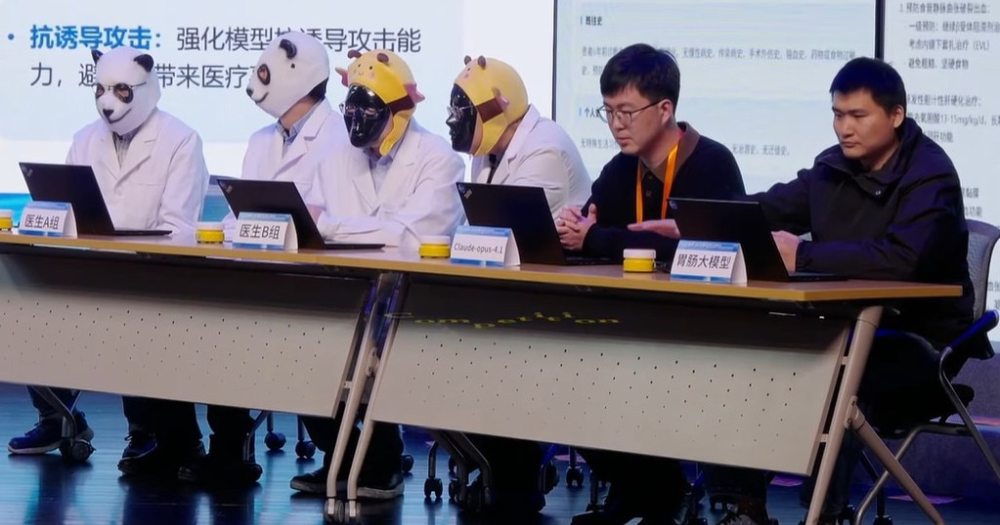
It looked more like a theater than a medicine. Masks. A live audience. A ticking clock.
In Shanghai, four senior physicians from elite hospitals faced off against artificial intelligence in a public diagnostic duel. The case was complex. Gastrointestinal. The pressure was real.
And the result was hard to ignore.
Two AI systems delivered answers in seconds. The doctors needed minutes — thirteen of them.
The event, staged at the Pujiang Medical AI Conference, was billed as the first Shanghai Medical AI Skills Competition. It was part spectacle, part science, and entirely intentional. China wanted to show what modern medical AI can do when the gloves come off.
How did it work?
The contest pitted human experience against machine speed.
On one side were four chief physicians. Their faces were hidden behind animal masks to keep the focus on performance, not reputation. They split into two teams and worked through a difficult gastrointestinal case in real time.
On the other side were two AI systems.
One was China's own Gastrointestinal Multimodal AI, built this year by Shanghai AI Lab in collaboration with local hospitals. It was trained on 30,000 real clinical cases. It can read endoscopy images. It can parse CT scans. It connects symptoms, visuals, and history at machine speed.
The second was an international model, unnamed but clearly included for comparison.
What happened next was almost unfair.
Both AI systems returned diagnoses in under two seconds. The doctors, methodical and careful as doctors should be, took about thirteen minutes.
According to ShanghaiEye, the Chinese system matched the physicians' diagnosis and treatment plan. The foreign model did not quite get there. It "fell slightly short in diagnostic accuracy."
Why does it matter?
Speed alone is not the point. Accuracy is.
This was not a toy demo or a lab simulation. It was a live, real world case in front of peers and policymakers. The Chinese AI did not just answer quickly. It answered correctly.
That changes the conversation.
As Luo Meng, deputy director of the Shanghai Municipal Health Commission, put it, "Through this real-world demonstration, we can see that future large models will undoubtedly play a valuable role in training our diagnostic and treatment skills and enhancing our overall capabilities."
That line matters. This is not about replacing doctors. It is about sharpening them.
Luo was explicit. "Of course, our goal is not to make AI models stronger for their own sake, but to use these powerful tools to make our doctors stronger."
Think of it like a calculator for the mind. It does not remove the need to understand math. It frees you to focus on judgment, nuance, and care.
The context
China is moving fast. Faster than many are comfortable admitting.
This competition did not happen in a vacuum. It sits at the intersection of several trends:
- Massive state investment in medical AI
- Close collaboration between hospitals and research labs
- A regulatory environment that favors real-world trials over endless pilots
- A health system under pressure from scale, aging populations, and uneven access
Western debates around medical AI often stall at ethics panels and hypotheticals. In Shanghai, they put the system on stage and hit start.
There is also a subtle message here. Domestic models matter. The fact that the Chinese system matched doctors while the foreign one lagged is not incidental. It signals technical confidence and strategic intent.
For clinicians, the takeaway is sobering but hopeful. AI will not replace the best doctors. But doctors who learn to work with AI will replace those who do not.
Like it or not, the future of diagnosis just walked onto the stage. And it did not need thirteen minutes to introduce itself.
Latest @
Dubai creates $100M fund to become global health tech hub
Qatar Red Crescent launches HAKEEM digital health platform
💡Did you know?
You can take your DHArab experience to the next level with our Premium Membership.👉 Click here to learn more
🛠️Featured tool
 Easy-Peasy
An all-in-one AI tool offering the ability to build no-code AI Bots, create articles & social media posts, convert text into natural speech in 40+ languages, create and edit images, generate videos, and more.
👉 Click here to learn more
