

Abu Dhabi signs four health deals that put AI, wearables and pharma under one roof
Most health systems collect partners. Abu Dhabi is trying to assemble a chain. Put an AI drug discovery lab, a wearable maker, a leading hospital and a global pharmaceutical company in the same announcement, and you are describing a path from molecule to bedside to wrist.
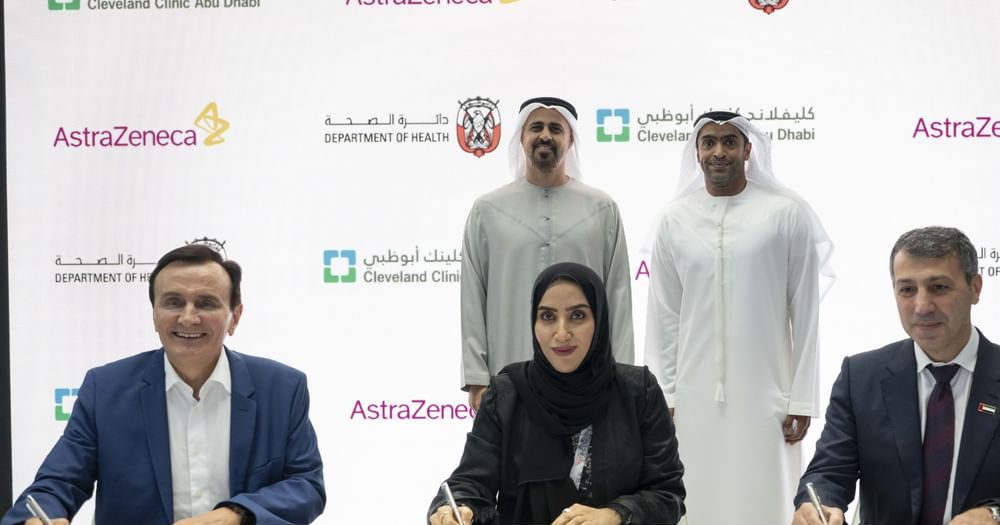
That is the picture emerging from agreements signed by the Department of Health – Abu Dhabi (DoH) with Isomorphic Labs, WHOOP, Cleveland Clinic Abu Dhabi and AstraZeneca. H.H. Sheikh Theyab bin Mohamed bin Zayed Al Nahyan, Deputy Chairman of the Presidential Court for Development and Fallen Heroes' Affairs, attended the signing. His presence tells us how the emirate rates the occasion: as national development policy, not routine procurement.
How will it work?
The full terms of each agreement have not been laid out in the material available so far, so it is wise to be careful about specifics. But the partners themselves suggest the shape of the project.
Isomorphic Labs, the Alphabet-linked company built on DeepMind's protein science, works on AI-driven drug design. WHOOP makes wearables that track sleep, strain and recovery continuously. Cleveland Clinic Abu Dhabi brings clinical delivery and research capacity. AstraZeneca brings late-stage development experience and trial infrastructure.
Read together, the roles line up like this:
- Isomorphic Labs: computational discovery of new treatments
- AstraZeneca: clinical development and pharmaceutical expertise
- Cleveland Clinic Abu Dhabi: patient care and clinical validation
- WHOOP: continuous, real-world health data from individuals
DoH sits in the middle as regulator and convener. That position matters, because it controls the rules on data, licensing and clinical standards.
Why does it matter?
Drug discovery is slow and expensive, and preventive care is only as good as the data behind it. Abu Dhabi is betting that AI and wearable data can improve both. If it works, residents could see earlier detection, more personalised care and faster access to new therapies.
There is also an economic argument. Life sciences is a stated pillar of diversification across the Gulf, and talent follows credible research programmes. A government that signs with global names, and gives them a real regulatory sandbox, is competing for that talent.
Still, announcements are cheap. The hard part is governance: who owns health data, how consent is handled, and how results reach patients rather than press releases. Clinicians and policymakers should watch those details closely.
The context
None of this appears from nowhere. Abu Dhabi has spent years building the foundations: the Malaffi health information exchange, the Emirati Genome Programme, the push on healthy longevity medicine and the investment vehicle M42. The UAE's National Strategy for Artificial Intelligence 2031 sets the wider direction.
The same logic runs across the region. Saudi Arabia's Vision 2030 health transformation programme, Qatar's genomics work and Bahrain's digital health reforms all point to governments treating data and biotechnology as strategic assets. The GCC is moving from buying healthcare technology to helping shape it.
So the real test for Abu Dhabi is delivery. If these four agreements produce shared research, validated tools and measurable patient benefit, other Gulf health authorities will copy the model. If they stall, they will become one more signing ceremony.
Latest @
Neuratia Labs picks CliniDataCue to solve the data problem facing its first research fellows
Robotics comes to the IVF lab as Abu Dhabi's fertility sector eyes automation
American Hospital Dubai to help build an AI billing platform, not just buy one
Mubadala and Khalifa University bet on lab-stage science with new life sciences programme
Abu Dhabi's biobank teams up with AstraZeneca to predict disease before it starts
💡Did you know?
You can take your DHArab experience to the next level with our Premium Membership.👉 Click here to learn more
🛠️Featured tool
 Easy-Peasy
An all-in-one AI tool offering the ability to build no-code AI Bots, create articles & social media posts, convert text into natural speech in 40+ languages, create and edit images, generate videos, and more.
👉 Click here to learn more
