

U.S. digital health funding hits $7.4B in H1 2026
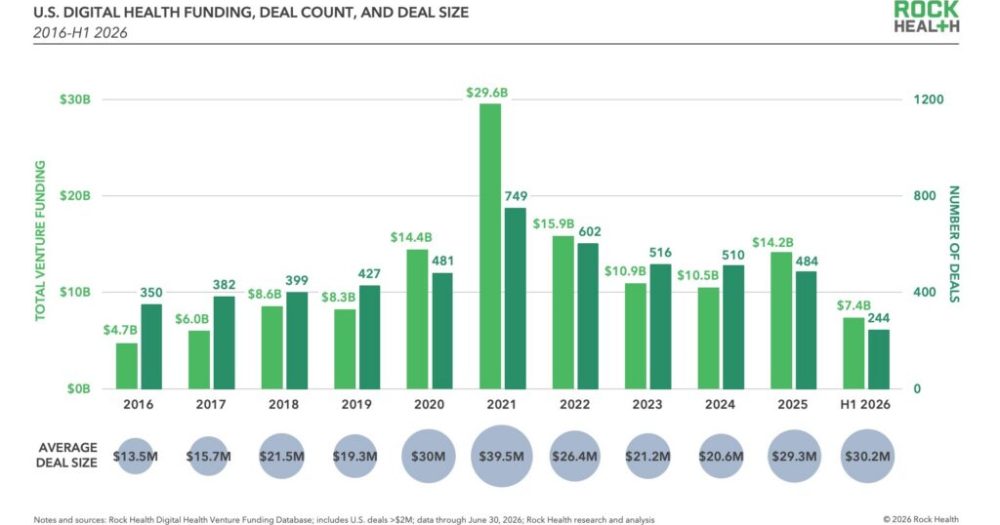
U.S. digital health startups raised $7.4 billion across 244 deals in the first half of 2026, according to Rock Health's latest funding report. That's $1 billion more than the same period last year, and it puts the sector on track for its strongest year since the post-pandemic correction bottomed out in 2023 and 2024. The recovery is real. But the distribution of that capital tells a more complicated story.
A small group of companies is capturing an outsized share of the money. Nineteen companies raised 20 deals of $100 million or more in H1, and those deals alone absorbed 45% of all capital invested. That's up from 22% in 2024. In plain terms, just over 8% of deals pulled in nearly half of all the money. The median deal size rose to $14 million, the highest since 2022, which sounds healthy until you realize how much of the overall total is sitting at the very top of the distribution.
The broader context here is AI. Generative AI has reset what's possible to build in healthcare, which means it has also reset what counts as a competitive advantage. A strong software product used to be a defensible position. Now it can be replicated faster and cheaper than ever before. Founders and investors are going back to basics, asking what actually holds up when the technology keeps changing underneath you.
The highlights
- U.S. digital health startups raised $7.4B in H1 2026, up from $6.4B in H1 2025
- Median deal size rose to $14M, the highest since 2022
- Mega deals ($100M+) represented 45% of all capital, up from 22% in 2024
- Mental health is the top-funded clinical indication for the seventh consecutive year, led by Talkiatry ($210M) and Grow Therapy ($150M)
- Weight management and obesity came in second, anchored by eMed ($200M), Nourish ($100M), and Midi ($100M)
- Digital health M&A reached 115 acquisitions in H1 2026, with Q2 being the busiest M&A quarter since Q3 2021
- Hinge Health has more than doubled its IPO price since going public last year, reporting 47% year-over-year revenue growth and a 23% free cash flow margin
- Oura filed the only digital health S-1 of the year so far; Whoop raised $575M at a $10.1B valuation
Why does it matter?
The question investors and buyers are now asking is not who has AI, but who has something AI alone can't provide. That shift is forcing founders to think differently about what makes their companies worth building.
Rock Health identifies four areas where durable advantage is emerging right now:
- Founder expertise: Deep domain knowledge matters more as AI lowers the barrier to building. Founders who genuinely understand the organizations they're selling to can spot real problems and earn trust faster.
- Scale and workflow ownership: Companies that control more of the healthcare operating layer give their AI more context to work with, which makes their products harder to replace. The risk is that expanding roadmaps from different vendors start overlapping, creating confusion for buyers.
- Hands-on implementation: Buyers have been burned by deployments that look good in demos and fall apart in practice. Some startups are now sending forward-deployed engineers to work inside client organizations and build custom workflows from within. Companies like Commure and Qualified Health have made this a core part of how they go to market.
- Network effects through partnerships: Every trusted integration or endorsement makes a product stickier. Abridge, for example, has partnered with Nvidia, AHIMA, the American Diabetes Association, and the American Academy of Family Physicians. Each relationship makes the next one easier to land.
On the exit side, digital health has not yet seen an IPO in 2026, despite several credible candidates waiting. Wearables are the most visible story: Oura filed its S-1 after raising a $900M round last October at an $11B valuation, while Whoop is preparing for a public debut in the coming years. Meanwhile, GoHealth filed for Chapter 11 bankruptcy and was delisted, and Vicarious Surgical also exited the public markets. The contrast between Hinge Health's performance and these failures shows just how much execution quality matters once you're public.
The context
Mental health has topped the digital health funding charts every year for seven years running. That staying power reflects a structural problem: demand for mental health care far exceeds the supply of providers, and AI offers a credible path to closing that gap at scale. But the category also carries real risk. General-purpose AI chatbots from frontier labs are being used for mental health support by millions of consumers, often with minimal clinical oversight, which creates both a competitive pressure and a safety concern for purpose-built startups. Investors are increasingly backing companies that build in third-party safety evaluations and dedicated clinician oversight.
The GLP-1 drug boom continues to drive investment in weight management. Pharma companies are moving closer to consumers through direct-to-patient channels, and digital health companies are building the infrastructure to support that shift. A Medicare pilot offering $50-per-month GLP-1s could significantly expand access. Adjacent peptide categories are also drawing early investor interest, though a scheduled FDA reclassification meeting in late July 2026 could reshape how those products are marketed and sold.
On the M&A side, revenue cycle management is the hottest area for consolidation right now. IKS Health bought TruBridge, Med-Metrix completed two deals back to back, and private equity firm Thoreau Group signed a $12 billion agreement to take control of Ensemble Health. Roche acquired PathAI to strengthen its diagnostics, and Dexcom bought Nutrisense to deepen its consumer metabolic platform. With many late-stage digital health companies now too large for most strategic acquirers to absorb, a public listing is increasingly the clearest path to liquidity, which means the IPO pipeline is likely to open up in the months ahead.
Latest @
75,000 samples in: inside Abu Dhabi's AI wastewater early-warning system
Dubai-founded Enhance raises $18.2 million to push deeper into US gym market
Saudi health minister signs MoU with Portugal in push to build global health partnerships
Neuratia Labs names ten fellows for its first global neuroscience research program
💡Did you know?
You can take your DHArab experience to the next level with our Premium Membership.👉 Click here to learn more
🛠️Featured tool
 Easy-Peasy
An all-in-one AI tool offering the ability to build no-code AI Bots, create articles & social media posts, convert text into natural speech in 40+ languages, create and edit images, generate videos, and more.
👉 Click here to learn more
