

US digital health startups raised ~$14.2 billion in 2025
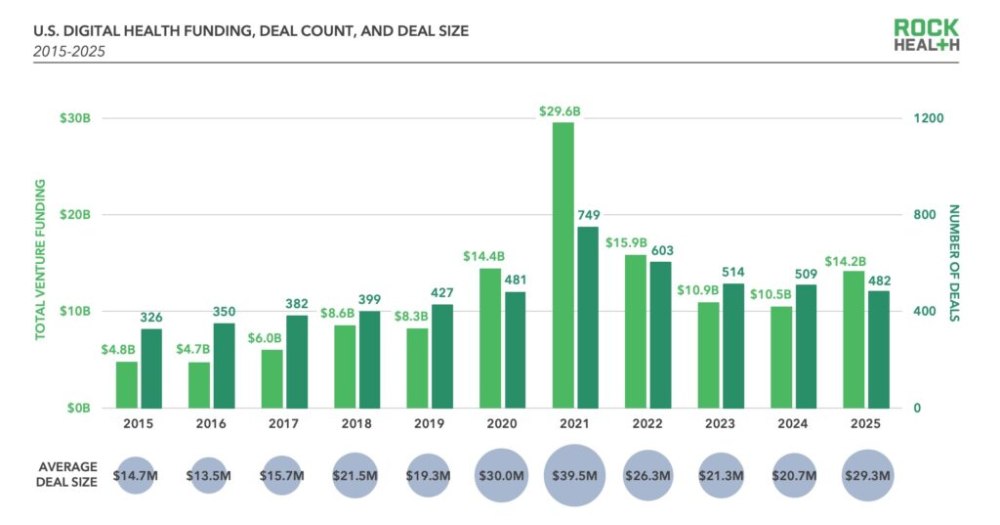
If you looked at the topline numbers, 2025 looked like a comeback year for digital health. Venture capital flowing into U.S. startups reached about $14.2 billion, up roughly 35 percent from 2024, and the highest total since 2022. It was a year of big rounds, bold bets, fresh public exits, and renewed confidence in tech that promises to remake healthcare. But dig a little deeper, and you see a different story. This wasn't a broad rally so much as a split market. A select few companies captured an outsized share of capital while many others struggled to level up.
Highlights
Here are the highlights:
- U.S. digital health startups raised roughly $14.2 billion in venture funding in 2025, a meaningful increase over the prior year.
- Q4 alone saw ~$4.2 billion across 129 deals, the most capital in a quarter since mid-2022.
- Capital concentrated at the top: mega rounds over $100 million made up about 42 percent of total funding.
- About half the deals went to companies that embed artificial intelligence at the core of their offerings, and these captured over half of all dollars raised.
- Five digital health companies broke their IPO drought and debuted publicly in 2025, signaling renewed exit paths.
Why does it matter?
Simply put, where the money goes tells you what investors believe will shape the future of healthcare. In 2025, AI wasn't just a buzzword; it was the magnet pulling dollars and shaping deal terms. Companies that leaned into artificial intelligence not only raised more dollars but also commanded larger deal sizes, a premium that wasn't as visible in prior cycles. The result is a bifurcated market: a rising class of well-capitalized leaders poised to scale, and a long tail of startups stuck in the middle. That split matters because it influences who gets to push innovation forward and who gets left behind. The funding patterns today could define how digital care, diagnostics, wellness, and workflow tools evolve over the next decade.
Investors are also signaling increased confidence in digital health as foundational infrastructure, not just an experimental playground. IPOs returning after years in hibernation suggests the public markets may finally be receptive to scalable healthcare tech. But that matters not just for founders or VCs. It matters for patients and providers, too, because funding shapes which tools get built, refined, and adopted at scale.
The context
The digital health funding landscape has been through its share of ups and downs. After a pandemic boom and a steep funding winter, by 2025, the sector had found a kind of new normal. The overall dollar figure sat about 36 percent above pre-pandemic levels when adjusted for inflation, even if total deal count dipped slightly.
Artificial intelligence took center stage. Roughly half of all digital health deals involved companies defined as AI-enabled, and these outfits snared more than half of the total funding — evidence that practitioners and investors see machine learning and advanced analytics as core to the next chapter in care delivery and back-office automation.
It wasn't all smooth sailing. More than a third of venture rounds in 2025 didn't represent a clear step up in valuation. That elevated number of flat or unlabeled rounds tells you that while the winners sprinted ahead, many others still wrestle with product-market fit, sales cycles, or simply breaking through the noise in a crowded field.
Mergers and acquisitions surged as well, suggesting that for some startups the path to growth is through consolidation rather than standalone scale. And the wider funding story fits a broader picture seen across healthcare and tech more generally: capital chasing long-term value over short-term hype, but doing so through a narrower funnel.
Latest @
Apple Vision Pro used in live hip surgery for the first time
75,000 samples in: inside Abu Dhabi's AI wastewater early-warning system
Dubai-founded Enhance raises $18.2 million to push deeper into US gym market
Saudi health minister signs MoU with Portugal in push to build global health partnerships
💡Did you know?
You can take your DHArab experience to the next level with our Premium Membership.👉 Click here to learn more
🛠️Featured tool
 Easy-Peasy
An all-in-one AI tool offering the ability to build no-code AI Bots, create articles & social media posts, convert text into natural speech in 40+ languages, create and edit images, generate videos, and more.
👉 Click here to learn more
