

M42 launches Ossi, a multi-agent AI platform built to give clinicians their time back
Ask any doctor in the Gulf what they would change about their working day, and few will say they want more technology. Most will say they want less typing. That is the problem M42 says Ossi is built to solve, and it is a more modest, more useful ambition than most AI announcements manage.
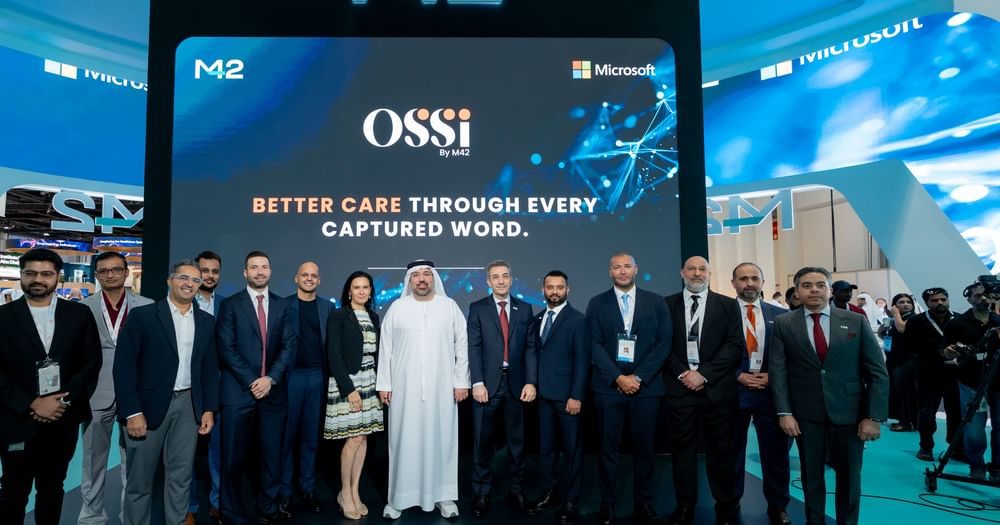
M42, the Abu Dhabi-based health group that combines artificial intelligence, technology and genomics, launched Ossi at the Abu Dhabi Future Health Summit. It describes the product as a next-generation, multi-agent AI Clinical Platform. The stated aim is to reduce administrative burden and give clinicians more time for patients.
One caveat first. The announcement material available so far is light on technical specifications, pricing and rollout dates. Those details matter, and readers should expect M42 to clarify them as deployments begin.
How does it work?
The phrase to focus on is "multi-agent". Instead of one large AI model trying to do everything, a multi-agent system splits work across several specialised software agents. Each handles a defined task, and they coordinate with one another. In a clinical setting, that typically means separate agents for jobs such as documentation, record retrieval or administrative follow-up, working in sequence under a single platform.
The appeal is practical. A narrow agent is easier to test, easier to audit and easier to restrict than a general-purpose tool. That matters in healthcare, where an error in a note or a summary is not a minor inconvenience.
M42 has positioned Ossi around the following priorities:
- Reducing the administrative workload that sits on clinicians' shoulders
- Returning time to direct patient care
- Running as a platform of coordinated agents rather than a single tool
How deeply Ossi connects to existing hospital records systems, and how clinicians review its output, will decide whether it works in daily practice. Those are the questions procurement teams should be asking.
Why does it matter?
Burnout is not a regional footnote. Health systems everywhere lose clinicians to long hours and heavy documentation, and the Gulf, which relies heavily on expatriate medical staff, feels the cost of turnover sharply. Every hour a physician spends on forms is an hour not spent examining, listening or deciding.
So the pitch is simple, and it is the right one. AI that supports the clinician, rather than competing with them, is far easier for hospitals to adopt and for regulators to accept. Tools that draft, sort and summarise carry lower risk than tools that diagnose.
But the claim has to be proved. Health leaders should look for measured results: minutes saved per consultation, error rates, clinician satisfaction and, importantly, patient outcomes. Time saved on paper means little if it is quietly refilled with new tasks.
The context
M42 is not a newcomer experimenting at the edges. The group sits at the centre of Abu Dhabi's strategy to build a data-driven health sector, with genomics as a core strength through work such as the Emirati Genome Programme. Ossi fits that pattern. Genomic data, clinical data and AI tooling are being assembled into a single ecosystem, and a clinical platform is the layer where doctors actually meet it.
The launch also reflects a wider GCC direction. Saudi Arabia's Vision 2030 health transformation program, the UAE's national AI strategy and Abu Dhabi's own healthcare ambitions all point toward digitised, preventive and personalised care. Each depends on a workforce that has the capacity to use the new tools. Easing administrative load is the unglamorous precondition.
Choosing the Abu Dhabi Future Health Summit as the stage was also deliberate. The event brings together policymakers, operators and investors, the same audience that decides which platforms get adopted across public systems.
Challenges remain, and they are familiar ones. Patient data protection rules differ across Gulf jurisdictions. Arabic-language clinical documentation is harder for AI than English. And clinicians trust tools only after those tools have earned it, not after a launch event.
Still, the direction is sound. If Ossi gives doctors back even a fraction of their day, and hospitals can show it, it will make a stronger case for clinical AI in the region than any benchmark score. Watch for pilot sites, published results and pricing. They will say more than the launch did.
Latest @
M42 and Siemens Healthineers set their sights on Africa
M42 launches Ossi, a multi-agent AI platform built to give clinicians their time back
Healthpoint brings Proximie into its Abu Dhabi operating rooms
Microsoft's AI doctor works up a case step by step, and beats the physicians
💡Did you know?
You can take your DHArab experience to the next level with our Premium Membership.👉 Click here to learn more
🛠️Featured tool
 Easy-Peasy
An all-in-one AI tool offering the ability to build no-code AI Bots, create articles & social media posts, convert text into natural speech in 40+ languages, create and edit images, generate videos, and more.
👉 Click here to learn more
